Collection messages
A stored message whose single parameter is a TArray of USTRUCT is a collection: listeners can take the
whole table, one fixed slot, or every changed row — and a row can be read without depending on the element type.
Declared in Plugins/GMP/Source/GMP/GMP/GMPStoreCollection.h
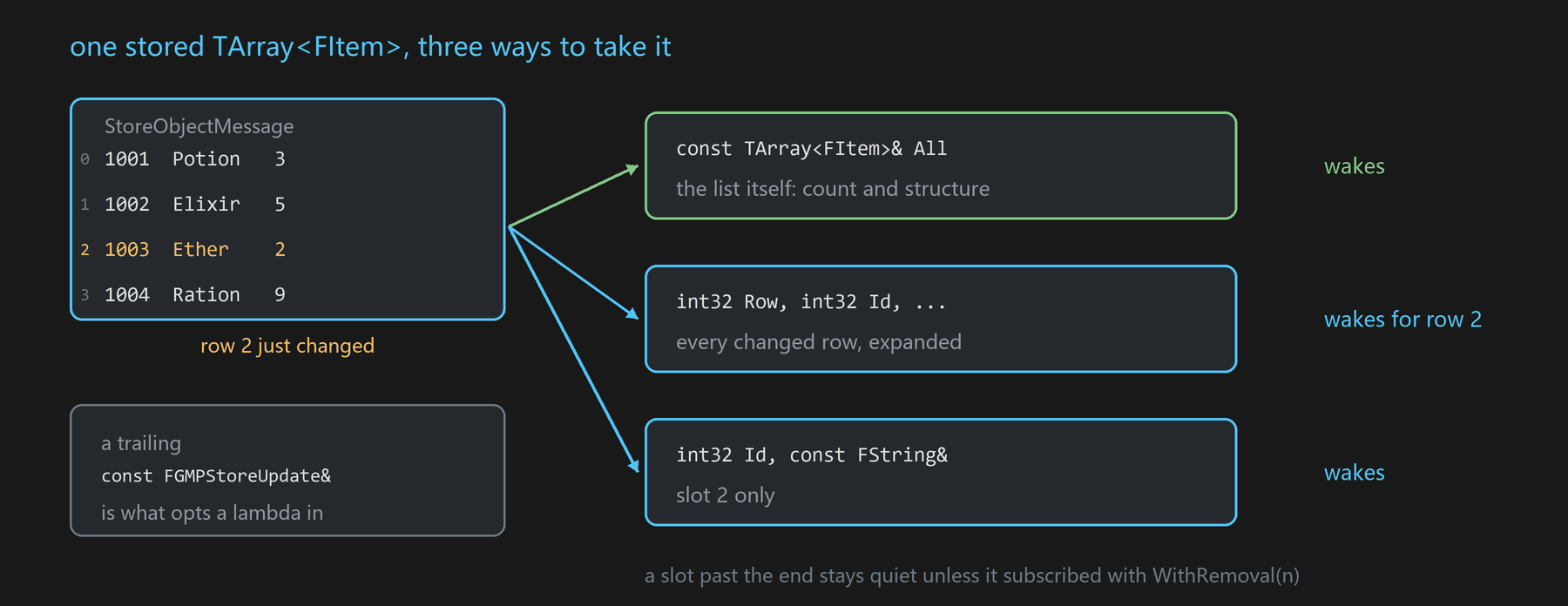
Nothing new to learn if you do not want it. StoreObjectMessage and ListenObjectMessage behave exactly as
before for every other shape; a collection is recognised from the stored parameter, not from a new entry point.
USTRUCT() struct FItem { GENERATED_BODY() UPROPERTY() int32 Id; UPROPERTY() FString Name; UPROPERTY() int32 Count; };

FGMPHelper::StoreObjectMessage(Obj, MSGKEY("Inv.Items"), MyItems);   // TArray<FItem>, existing API
The only new requirement is that the element is a USTRUCT. Storing the whole table again is diffed against what
is already there with UScriptStruct::CompareScriptStruct, so handing GMP the full array is as precise as editing
it in place — a run of differing elements becomes one span, an unchanged table publishes nothing.
To edit without rebuilding the array, use the writer:
{
    TGMPStoredArray<FItem> Arr(Obj, MSGKEY("Inv.Items"));
    Arr.GetMutable(5).Count -= 1;
    Arr.Add(FItem{1002, TEXT("Elixir"), 5});
    Arr.RemoveAt(7);
}   // one fire on destruction, spans merged
It is stack-only by design — a heap or member instance would defer or lose the notification. operator[] is
const; writing goes through GetMutable(i), because a non-const operator[] cannot tell whether the caller
actually wrote anything and would have to mark the row anyway.
A table that is recomputed every tick — radar blips, currently visible actors, nearby interactables — is not worth storing. Send it instead:
FGMPHelper::SendObjectMessage(Obj, MSGKEY("Radar.Blips"), CurrentBlips); // nothing is keptThe row expansion still applies, but only AllRows listeners are woken, and the update is always a full
reload. There is no stored table to diff against, so there is no change set — and a slot listener, whose whole
point is not firing when someone else's row changed, would fire on every send. It stays quiet instead. There is
no late replay either: a listener arriving after the send gets nothing.
StoreObjectMessage |
SendObjectMessage |
|
|---|---|---|
| a listener arriving late | replayed once | nothing |
| which rows changed | exact ranges | whole table only |
| slot subscription | works | never fires |
TGMPStoredArray |
works | not applicable |
struct FGMPStoreRange { int32 Index; int32 Count; };

struct FGMPStoreUpdate
{

    int32 TotalCount;                          // the table size after the change
    TArrayView<const FGMPStoreRange> Ranges;   // which rows now read differently
    int32 PrevTotalCount;                      // the size before it, to tell "gone" from "never existed"
    int32 Row;                                 // row callbacks only: >= 0 this row, < 0 means ~Row is gone
    bool  IsFullReload() const;
    bool  IsRowRemoved() const;                // Row < 0
    int32 GetRow() const;                      // the row number either way
};
There is no add/change/remove enum: the two dimensions carry it. The count says whether the table resized, the
index says where — changing row 3 keeps the count, inserting at 3 raises it, removing at 3 lowers it. A resize
widens Ranges to the tail, because every row after the first touched one now holds different content.
ListenObjectMessage(SigSrc, K,        Listener, Lambda);   // whole table
ListenObjectMessage(SigSrc, K, Index, Listener, Lambda);   // by row, see the encoding below
Index says which row and whether removals are wanted, with one ~ rule shared by the callback side:
Index |
means | told when the row is gone |
|---|---|---|
5 |
slot 5 | no |
GMP::WithRemoval(5) (= ~5) |
slot 5 | yes |
GMP::AllRows (= MAX_int32) |
every changed row | no |
GMP::AllRowsWithRemoval (= ~MAX_int32) |
every changed row | yes |
The callback side reads the same way: U.Row >= 0 is a live row, U.Row < 0 means ~U.Row is gone. Asking for
removals is what costs — shrinking a table from 10 rows to 3 calls a subscriber that wanted them 7 times — so it
is opted into at the listen site rather than inferred.
A lambda ending in const FGMPStoreUpdate& opts into the collection; without it the listen is an ordinary
message listen, unchanged. Four shapes:
// whole table, strongly typed -- a reference to the stored array, no copy
[](const TArray<FItem>& All, const FGMPStoreUpdate& U){ ... }

// whole table, no dependency on the element type
[](FGMPStoreView View, const FGMPStoreUpdate& U){ ... }

// notification only
[](const FGMPStoreUpdate& U){ ... }

// per row, through the Index overload -- members expand positionally, so no element type is needed
FGMPHelper::ListenObjectMessage(Obj, K, GMP::AllRows, this, [](int32 Row, int32 Id, const FString& Name, int32 Count){ ... });
FGMPHelper::ListenObjectMessage(Obj, K,           5, this, [](int32 Id, const FString& Name, int32 Count){ ... });

// slot 5, told when it goes away -- the trailing update is what tells the two apart
FGMPHelper::ListenObjectMessage(Obj, K, GMP::WithRemoval(5), this,
    [](int32 Id, const FString& Name, int32 Count, const FGMPStoreUpdate& U)
    {
        if (U.IsRowRemoved()) { /* Id/Name/Count are default here -- do not read them */ }
    });
A stored table is replayed to a listener that arrives late, as with any StoreObjectMessage. Unlistening is
the existing UnbindMessage(K, Listener) family — a collection listener dies with its UObject or
FSigHandle like any other.
Index >= 0 means what is displayed at row N, which is what a virtual list row widget wants:
| slot 5 | |
|---|---|
| row 5 edited | fires |
| row 3 edited | does not fire |
| insert at 3 | fires — the old row 4 moved into position 5 |
| remove at 3 | fires — the old row 6 moved into position 5 |
| insert or remove at 8 | does not fire |
| the table shrank past 5 | fires with Row < 0 if the listen asked for removals, otherwise not |
A slot subscription is not invalidated by its position disappearing — the table growing back calls it again. Two
ways to handle the gap, both supported: subscribe plainly and let the whole-table listener destroy the row widget
(whose destruction unlistens), or ask for removals with WithRemoval and have the widget react itself — play an
exit animation, clear its display — without depending on someone else to tear it down.
struct FGMPStoreView            // borrowed; valid only for the callback
{
    int32 Num() const;
    template<typename F> void VisitRow(int32 Row, F&& Lambda) const;   // (Id, Name, Count)
    template<typename F> void ForEach (F&& Lambda) const;              // (Row, Id, Name, Count)
    template<typename T> const TArray<T>& As() const;                  // when you do have the type
};
Members expand by declaration order of the element struct, read through reflection, so a UI module can consume a table defined by a gameplay module without including its header. A lambda may declare only the first few members.
Editor-only members are skipped. A WITH_EDITORONLY_DATA member would otherwise sit in the middle of the
sequence in editor and vanish in shipping, and a positional lambda would read a different field per
configuration. Skipping makes the visible sequence the same everywhere.
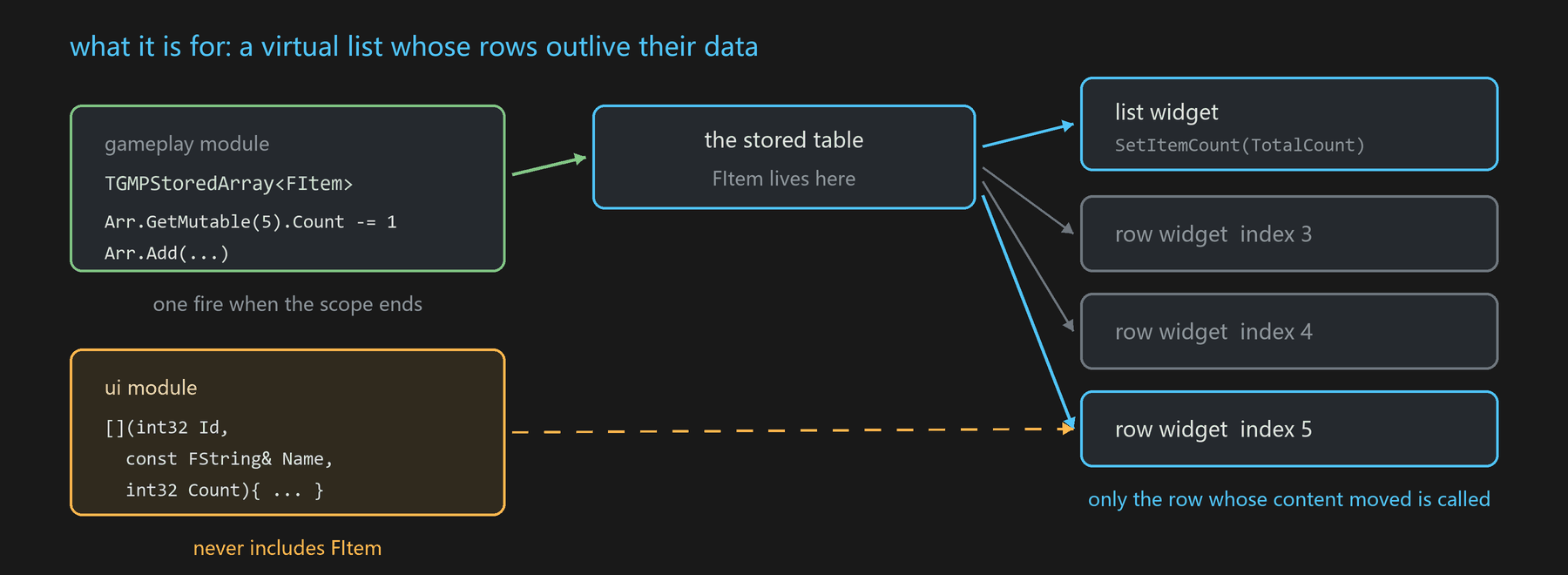
A virtual list recycles a fixed set of row widgets over a moving table, which is exactly the shape this fits: the
list widget follows TotalCount, each row widget follows its own position, and the module that draws the rows
never learns the element type. A row widget is not called once its position is past the end, so it never has to
ask whether it still has data — unless it asked for removals, in which case it is told exactly once.
The case it is really aimed at is instances that come and go at run time — party members, spawned entities, inventory rows, a scoreboard. The data side edits an array; nobody allocates a per-instance object for the UI to hold, and nobody has to tear one down.
There are now two ways to say "the same key, but a different one of these", and they answer different questions.
| one key, several sources | one key, one table, several rows | |
|---|---|---|
| how | a different FSigSource per instance, or ExactObjName
|
a row index into the stored array |
| fits | instances that are long-lived objects and own their state | instances that appear and disappear, consumed by recycled widgets |
| identity | the object | the position |
| lifetime | the store dies with its source | rows are just array elements |
Nothing is ever pushed at a row: a row subscribes to its own position. That is why a row consumer does not have
to handle "the thing I was showing is gone" — it holds a slot number, not an entity, and by default a slot past
the end is simply not called, leaving the whole-table listener to see TotalCount and destroy the widget. A row
that would rather know can ask, with WithRemoval.
The cost of that choice: a position is not an identity. If what you mean is "the head equipment slot, and I do not care what other slots do", an index cannot express it — inserting anything before it moves it. That case wants a key field on the element and is a separate piece of work, deliberately not folded into this one.
It is an observable table, not a view model. There is no object per row, no per-field notification, no write-back through the binding, and no editor that compiles bindings for you. Those all need a typed object on both ends of the binding, which is the thing the string key exists to avoid — adding them here would buy back the coupling.
Nothing stops a view model from sitting on top: it can be a collection listener internally, and then it is the one deciding what a field-level change means for it.
Rows reach the script backends through one shared entry, so all of them see the same (int32 Row, Item) pair and
the same Index encoding as C++. A removed row arrives with a negative row and a default-constructed item.
-- slua / UnLua
local key = GMP.ListenRowMessage(WatchedObj, "Inv.Items", WeakObj, 5, function(Row, Item)
    if Row < 0 then return end                      -- ~Row is gone, Item is a default
    Label:SetText(Item.Name)
end)
// Puerts
GMP.ListenRowMessage(WatchedObj, "Inv.Items", WeakObj, GMP.AllRows, (Row: number, Item: FItem) => { ... });AngelScript is typed, so a collection tag additionally generates a funcdef and a per-tag entry into
Script/GMPMessages.as, checked at compile time like the other generated bindings:
funcdef void FOnRow_Inv_Items(int Row, FItem Item);
int64 asListenRow_Inv_Items(UObject WatchedObj, UObject WeakObj, int Index, FOnRow_Inv_Items@ cb, int Times = -1);
Lifetime is an ordinary GMP listener registered by that shared entry, so UnbindMessage and the rest of the
unbind family work on a row listen with no script-specific teardown.
The whole-table form needs nothing new: the tag's parameter is TArray<FItem>, and a listen node already gives
an array pin.
For rows, right-click a listen node on a collection tag — a Collection section offers Whole Table (the
default) or Row. Row mode adds an Index input and gives (Row, Item) outputs; the node titles itself
ListenMessageRow. Index is an ordinary pin, so a row widget can subscribe to its own row number at run time.
The section only appears for a tag that carries one array of structs.
Index takes the same encoding as C++, and the Row output carries it back: a negative Row means that row is
gone and Item is a default. Branching on Row < 0 is the blueprint equivalent of IsRowRemoved().
Measured with -run=GMPUnitTest -Bench (64 rows, best of three, Development editor):
| dispatch, whole table, one listener | 56 ns |
| dispatch, 64 slot listeners, one wakes | 253 ns |
ForEach per row, compiled offsets |
0.9 ns |
ForEach per row, reflection |
10 ns |
| for scale: an ordinary GMP slot send | ~690 ns |
ForEach reads rows at compiled offsets when the arguments a lambda declares line up with the element layout —
same offset, same width, same type for each declared member — and falls back to reflection when they do not.
Correctness never depends on the shortcut; a mismatch (an editor-only member shifting the rest, a missing
UPROPERTY, a same-width different type) just takes the slower path. A slot or per-row listener makes that
decision once, on its first fire, and remembers it.
- The element must be a
USTRUCT; members that participate must beUPROPERTY. - A removal in the middle of a table published as a whole reports one wide span, not "one row removed" — recognising that needs a sequence diff.
-
FGMPStoreViewis borrowed. Do not store it past the callback. - A slot subscription never fires for a plain
SendObjectMessage— by design, not a defect. Without a stored table there is no change set, so it would fire on every send instead of only when its own row changed. - Subscribing by name rather than by index is not implemented; the design keeps
TArrayand marks a key field withmeta=(GMPKey)rather than switching toTMap, so index and name can coexist.
Long-form: Collection messages — the reasoning and the trade-offs, where this page is the reference.
StoreObjectMessage · ListenMessage family · FGMPStructUnion · FSigSource