Topology-aware Koopman autoencoders for forecasting and analyzing networked dynamics



Documentation | Tutorials | API | Contributing | Citation
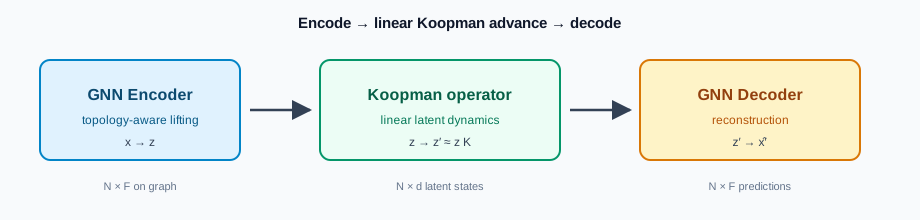
KoopmanGraph is an open-source PyTorch Geometric library for learning topology-aware Koopman autoencoders on graphs. GNN encoders lift node features into a latent space, a learned linear operator advances those states, and a matching decoder reconstructs physical node features for multi-step forecasting and spectral analysis.
It is aimed at researchers studying networked dynamical systems—smart grids, traffic networks, epidemic contact graphs, and similar domains—who want an inspectable linear latent operator instead of a flat-vector Koopman model or a purely nonlinear GNN forecaster.
Koopman theory maps nonlinear dynamics into a linear latent domain where multi-step forecasting and spectral analysis are natural. Existing deep Koopman packages typically ignore graph structure, while spatiotemporal GNN forecasters usually lack an explicit linear latent operator.
KoopmanGraph bridges that gap with GNN lifting/decoding, an inspectable Koopman matrix K, row-state latent advance fit / predict workflow.
The library sits in the consistent Koopman autoencoder lineage and is not claimed as a new theoretical contribution; it packages topology-aware lifting, linear latent evolution, and analysis tooling for networked dynamical systems.
- Topology-aware learning — GCN/GAT/hypergraph encoders and decoders, delay embeddings, dynamic topology, optional self-adaptive edges, sheaf / cell / simplicial lifts, and a predicted-topology head (distinct from static AdaptiveAdjacency)
-
Flexible dynamics — discrete, continuous-time, networked (
koopman="graph"), hypergraph, multiplex hetero, global/local, Hodge-structured, switched, and mixture operators, with soft, structural, stochastic, or symplectic parameterizations -
Forecasting stack — multi-step rollout, consistency losses, temporal evaluation metrics, checkpointing, and restricted
torch.export/ TorchScript (fixed-topology homogeneous MVP) -
Spectral analysis — eigendecomposition, mode shapes, finite ResDMD on
evaluate, Kronecker dispersion, dynamical similarity, anomaly helpers, and optional 0-d TDA extras -
Control and adaptation — additive/bilinear control, iterated-QP Koopman-MPC (
[mpc]), online RLS adaptation, Kalman observation, and a Gymnasium RL wrapper -
Research tooling — classical DMD-family baselines, teaching GNN ports plus LibCity/BasicTS leaderboard adapters, GraphVAMP / alanine-dipeptide teaching fetch, conformal UQ, and a
$K^2$ VAE MVP -
Optional distributed trainers — native DDP /
torchrun, Lightning Fabric, Ray ensemble helpers, opt-in multi-node Ray recipe (KOOPMAN_GRAPH_MULTINODE=1), and in-tree FedAvg ([federated])
Full inventory: Capabilities · Architecture
Scope. KoopmanGraph targets topology-aware Koopman autoencoders on graphs and hypergraphs. Leaderboard adapters follow named protocols; they are not dedicated-library SOTA. Sheaf / cell / Hodge / TopologicX-bridge paths keep a linear Koopman head. GraphVAMP and the alanine-dipeptide fetch are teaching / diagnostic — not Folding@home-scale MD. Measured limits (finite ResDMD, restricted export, federated-not-DP, conservation on
Requires Python 3.10+, PyTorch, and PyTorch Geometric. Install those first, then:
pip install koopman-graph
# or: uv pip install koopman-graph
See the installation guide for editable installs, uv workflows, docs builds, and platform-specific wheels. Release notes: CHANGELOG.md.
import torch
from koopman_graph import GNNDecoder, GNNEncoder, GraphKoopmanModel
from koopman_graph.datasets import SyntheticDynamicGraphBenchmark

data_sequence = SyntheticDynamicGraphBenchmark.generate(
    num_nodes=20,
    num_timesteps=30,
    in_channels=3,
    seed=42,
    noise_std=0.01,
)

encoder = GNNEncoder(3, 64, 64)
decoder = GNNDecoder(64, 64, 3)
model = GraphKoopmanModel(
    encoder=encoder,
    decoder=decoder,
    latent_dim=64,
    time_step=0.1,
)

torch.manual_seed(0)
history = model.fit(data_sequence, epochs=20, lr=1e-3)
future_graphs = model.predict(data_sequence[0], steps=5)
spectrum = model.spectrum()

print(f"Final loss: {history.loss[-1]:.6f}")
print(f"Predicted {len(future_graphs)} snapshots, shape: {future_graphs[0].x.shape}")
print(f"K eigenvalues: {tuple(spectrum.eigenvalues.shape)}")
print(f"Top |λ|: {spectrum.magnitudes[:3].tolist()}")
The constructor factory-builds a discrete per-node KoopmanOperator. Pass koopman="graph" when edge_index should enter the linear step (defaults are otherwise unchanged):
graph_model = GraphKoopmanModel(
    encoder=encoder,
    decoder=decoder,
    latent_dim=64,
    time_step=0.1,
    koopman="graph",
)
Expected output:
Final loss: <float>
Predicted 5 snapshots, shape: torch.Size([20, 3])
K eigenvalues: (64,)
Top |λ|: [<float>, <float>, <float>]
More detail: Quickstart guide · API reference
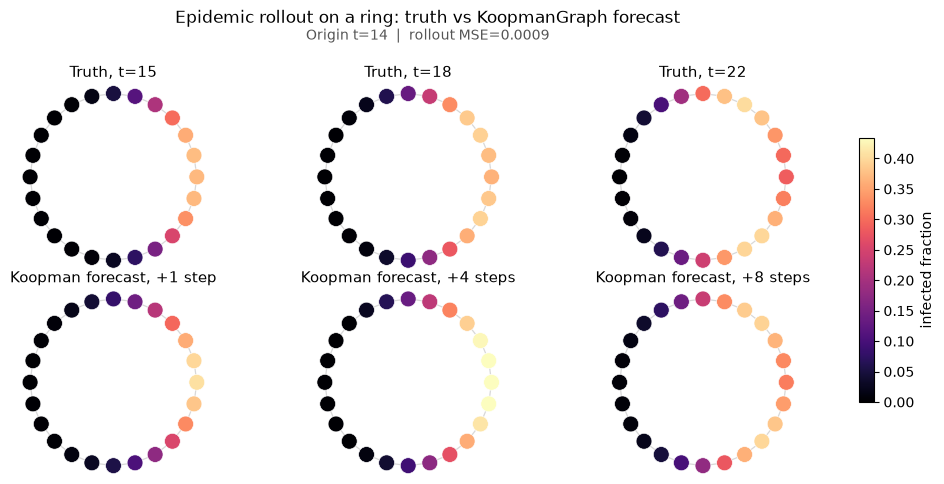
SIR epidemic on a ring: truth vs forecast from examples/06_epidemic_ring.ipynb.
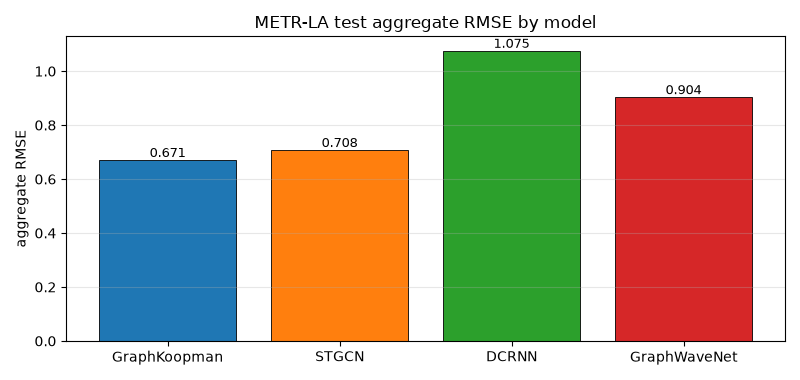
METR-LA aggregate RMSE vs in-repo STGCN / DCRNN / Graph WaveNet teaching baselines (not dedicated-library SOTA) from examples/22_gnn_forecaster_comparison.ipynb.
Featured tutorials: 01 synthetic · 03 traffic · 06 epidemic · 22 GNN baselines · 37 topology transfer · 39 hetero RelGraph · 42 teaching baselines · full gallery
- Quickstart — train / predict walkthrough
- Capabilities — feature inventory and datasets
- Scope and limitations — when not to use; measured boundaries
- Architecture — public vs power-user API layers
- FAQ / troubleshooting — install, imports, checkpoints
- Installation — dependencies, install paths, and CI platforms
-
CLI —
koopman-graph train/predictconfig workflow - SECURITY.md — supported versions and checkpoint trust boundaries
- What’s new in 0.14.0: opt-in stochastic / symplectic
$K$ , switched / mixture / Hodge operators, equivariant block$K$ , leaderboard adapters, restrictedtorch.export/ TorchScript, wired finite ResDMD, and TDA / federated extras — defaults unchanged vs 0.13.0; see CHANGELOG.md.
- PyKoopman and DLKoopman target vector-valued Koopman / deep-Koopman workflows; they treat the state as a flat vector rather than propagating information along graph edges.
- PyTorch Geometric provides mature GNN infrastructure on irregular graphs; KoopmanGraph adds an explicit linear latent operator, consistency losses, and a documented
fit/predictforecasting stack on that substrate. - Spatiotemporal GNN forecasters such as STGCN, DCRNN, and Graph WaveNet typically learn nonlinear convolutional or recurrent maps on graphs; KoopmanGraph instead advances an inspectable linear Koopman matrix K (see in-repo teaching baselines in examples/22).
- Contribute, report issues, or seek support: CONTRIBUTING.md · Support · Code of Conduct
- Install / runtime troubleshooting: FAQ
- Security vulnerabilities (private): SECURITY.md
- Development checks and release process: CONTRIBUTING.md
If you use KoopmanGraph in research, please cite:
@software{koopmangraph2026,
  author       = {Travis Kessler},
  title        = {KoopmanGraph: Topology-Aware Koopman Autoencoders for Networked Dynamics},
  year         = {2026},
  publisher    = {Zenodo},
  doi          = {10.5281/zenodo.21926723},
  url          = {https://github.com/tjkessler/KoopmanGraph},
  version      = {0.14.0},
}KoopmanGraph is released under the Apache License 2.0.