
Controlled experiments for coding-agent harnesses.
Website | Install | How it works | SWE-bench | Documentation


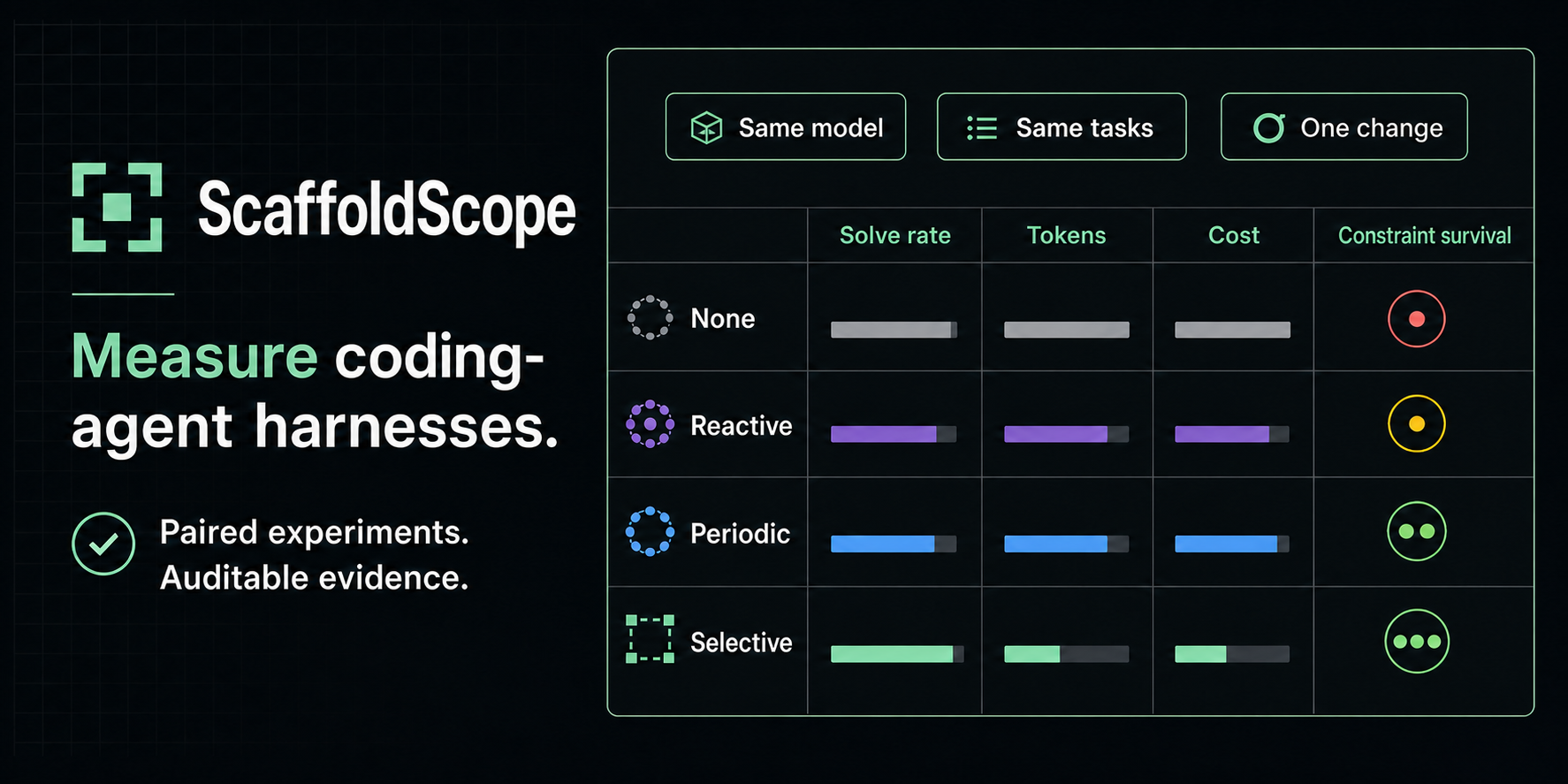
ScaffoldScope measures how coding-agent harness choices affect solve rate, token use, cost, and constraint retention. It holds the model, tasks, evaluator, and budget fixed while one scaffold treatment changes.
Same model. Same tasks. Same budget. One scaffold mechanism changed.
It combines a readable Python agent, a paired experiment runner, and an evidence pipeline. Use it to compare context policies, tool surfaces, and treatment instructions; evaluate locally or in a locked-down Docker backend; export a complete SWE-bench matrix; and publish deterministic evidence archives.
ScaffoldScope supports Python 3.10 through 3.14 on Linux, macOS, and Windows. Docker is optional and only required for container-isolated evaluation.
Install from PyPI:
python -m pip install scaffoldscope
scaffoldscope --version
To work from source instead:
git clone https://github.com/satwiksps/scaffoldscope.git
cd scaffoldscope
python -m pip install .
Then run the zero-cost local starter:
scaffoldscope init my-study --name my-study
scaffoldscope validate my-study/experiment.json
scaffoldscope budget my-study/experiment.json
scaffoldscope run my-study/experiment.json
The generated project is safe to rerun and includes a tiny repository, fixed tests, a task manifest, and three context treatments. Its deterministic scripted provider costs nothing and validates the core local workflow without pretending to measure model intelligence.
For the larger built-in engine demonstration:
scaffoldscope demo| Goal | Start here |
|---|---|
| Learn the experiment format without API cost | scaffoldscope init my-study --name my-study |
| Exercise the complete local engine | scaffoldscope demo |
| Run a real OpenAI-compatible model | Real models |
| Evaluate untrusted repository code | Docker evaluation |
| Compare treatments on SWE-bench | SWE-bench |
| Capability | What ScaffoldScope does |
|---|---|
| Paired design | Can deterministically randomize treatment order inside each task and replicate block |
| Honest denominators | Keeps harness and protocol failures in intention-to-treat results while separating infrastructure-invalid trials |
| Resume integrity | Hashes config, implementation, plugin code, task source, and runtime identity before reusing a trial |
| Auditable context | Preserves the canonical trajectory; every derived view records retained and dropped source IDs |
| Cost provenance | Separates provider usage from estimates, cache reads/writes, retries, and incomplete ledgers |
| Governance metrics | Reports lexical constraint availability, behavioral checks, and governed solves separately |
| Evidence portability | Produces reports, raw traces, patches, immutable evaluator overlays, and deterministic ZIP bundles |
| Safe extension | Loads versioned entry-point plugins lazily and fingerprints their implementation |
The bundled scripted experiments are workflow tests only. ScaffoldScope withholds intervals for scripted runs and panels below 10 tasks. It labels a comparison inferentially ready only when it is the preregistered primary contrast, covers at least 20 tasks, and has at least 98% pair coverage.
| Policy | Trigger | Mechanism |
|---|---|---|
none |
Never | Full canonical history until a typed overflow |
reactive |
Utilization threshold | Deterministic salient summary plus recent atomic bundles |
periodic |
Every k turns | Fixed-cadence compaction with emergency pressure handling |
selective |
Utilization threshold | Budgeted 0/1 selection scored by recency, references, subgoals, errors, task relevance, and constraints |
Assistant action and tool-result messages form atomic bundles: a policy keeps or drops the pair, never half of it.
Each variant can expose an exact subset of the built-in tools and append treatment-specific instructions:
{
  "id": "symbol-first",
  "policy": "selective",
  "tools": ["list_files", "read_file", "search_symbols", "replace", "run_tests"],
  "instructions": "Use symbol search before opening broad files."
}
Available tools are list_files, read_file, search, search_symbols, replace, write_file, and run_tests. There is no model-controlled arbitrary shell.
# Freeze and inspect the matrix before any provider call
scaffoldscope schema --out experiment.schema.json
scaffoldscope validate experiment.json
scaffoldscope doctor --config experiment.json
scaffoldscope budget experiment.json
scaffoldscope plan experiment.json

# Execute or safely resume
scaffoldscope run experiment.json
scaffoldscope status runs/my-study-abc12345
scaffoldscope trials runs/my-study-abc12345 --jsonl

# Inspect one trace without invoking a model or a tool
scaffoldscope replay runs/my-study-abc12345 <trial-id>

# Rebuild and verify publication artifacts
scaffoldscope report runs/my-study-abc12345
scaffoldscope check runs/my-study-abc12345
scaffoldscope bundle runs/my-study-abc12345 --out my-study-evidence.zip
scaffoldscope verify-bundle my-study-evidence.zip
Every trial owns its workspace and artifacts. Parallel workers never append to a shared result file, and an OS-released lock excludes a second experiment writer. Matching completed trials resume without another model call; identity drift is rejected instead of silently mixing evidence.
| Artifact | Purpose |
|---|---|
manifest.json and config.resolved.json |
Frozen experiment identity and resolved configuration |
plan.jsonl |
Complete task, treatment, replicate, and execution-order matrix |
episodes.jsonl |
One durable result row per planned trial |
trials/<trial-id>/events.jsonl |
Ordered model, context, tool, evaluation, and lifecycle events |
trials/<trial-id>/patch.diff |
Exact repository change produced by the trial |
summary.json, report.md, report.html |
Machine-readable and human-readable analysis |
| Evidence ZIP | Workspace-free archive with checksums and integrity metadata |
The built-in adapter targets OpenAI-compatible /chat/completions APIs. Start from a generated project so its task and workspace paths remain valid, then replace only the model object in real-model-study/experiment.json. Pin an immutable model revision whenever the provider exposes one:
{
  "provider": "openai_compatible",
  "name": "pin-an-exact-model-revision",
  "base_url": "https://your-provider.example/v1",
  "api_key_env": "OPENAI_API_KEY",
  "requires_api_key": true,
  "context_window_tokens": 32768,
  "max_output_tokens": 2048,
  "json_mode": true
}
scaffoldscope init real-model-study --name real-model-study
# Edit real-model-study/experiment.json and configure its model object.
export OPENAI_API_KEY="..."
scaffoldscope validate real-model-study/experiment.json
scaffoldscope doctor --config real-model-study/experiment.json
scaffoldscope budget real-model-study/experiment.json
scaffoldscope plan real-model-study/experiment.json
scaffoldscope run real-model-study/experiment.jsonexamples/openai-compatible.example.json shows the complete optional model and pricing fields. It is a reference template, not a runnable experiment by itself: its provider URL and model revision are placeholders, and task paths are resolved relative to the configuration file.
Local Ollama or vLLM endpoints can explicitly disable authentication:
{
  "provider": "openai_compatible",
  "name": "local-model-revision",
  "base_url": "http://127.0.0.1:11434/v1",
  "requires_api_key": false,
  "context_window_tokens": 32768
}
Remote endpoints carrying a key must use HTTPS. Provider-specific adapters can be installed as plugins.
LocalSandbox is designed for trusted fixtures; it is not an OS security boundary. For untrusted repository tests, select the Docker backend with a locally available digest-pinned image:
{
  "sandbox": {
    "backend": "docker",
    "test_timeout_seconds": 120,
    "docker": {
      "image": "python@sha256:<64-hex-digest>",
      "platform": "linux/amd64",
      "cpus": 2,
      "memory_bytes": 2147483648,
      "pids_limit": 256
    }
  }
}
The backend never pulls during a run. It preflights the exact local image, disables networking, runs as non-root, drops all capabilities, uses a read-only root, protects evaluator files, scrubs harness credentials, and applies CPU, memory, process, file-descriptor, output, and timeout limits. Read the Docker threat model and setup guide.
ScaffoldScope generates patches; the official SWE-bench harness remains the correctness authority.
scaffoldscope import-swebench swe-bench-lite.json \
  --repo-cache /bench/repos \
  --out tasks/swe-bench-lite.jsonl

scaffoldscope run experiments/swe-bench-lite.json
scaffoldscope export-swebench-matrix runs/lite-ablation-abc12345 \
  --out-dir evaluator-matrix \
  --dataset-name SWE-bench/SWE-bench_Lite
The matrix contains one prediction file and a unique evaluator run ID for every treatment and replicate cell, plus a pinned runbook and checksums. After official grading, attach each cell as an immutable overlay:
scaffoldscope ingest-swebench runs/lite-ablation-abc12345 official-results.json \
  --strategy selective --replicate 1729 \
  --evaluator-version <commit> \
  --evaluator-run-id <unique-run-id> \
  --image-set-digest <image-manifest-digest>
See the SWE-bench workflow for cache hazards, evaluation commands, and interpretation limits.
Context policies and model providers use normal Python entry points:
scaffoldscope plugins
scaffoldscope plugins --check
Discovery is deterministic. Built-in names cannot be shadowed, compatibility ranges are checked, plugin options are passed through a typed request, and loaded implementation files are hashed into experiment identity. Start with the extension contract and the standalone example plugin.
Reports keep the trade-offs visible instead of compressing them into one score:
- Solve rate, governed solve rate, and paired wins/losses/ties.
- Task-cluster bootstrap intervals and a paired sign-flip test when inference is defensible.
- Uncached input, cache-read, cache-write, output, reasoning, and total-token summaries.
- Configured-price estimates, model/tool/wall time, and incomplete usage disclosure.
- Context pressure, compaction exposure, compression ratio, and selection decisions.
- Lexical constraint availability and machine-checkable behavioral adherence.
- Infrastructure, harness, overflow, turn, token, cost, and evaluator failure rates.
The deterministic evidence bundle excludes mutable workspaces, retains archived attempt evidence, and includes a SHA-256 manifest. Raw traces can still contain source code and prompts; review them before publication.
- Replicates are nested within tasks; they do not inflate the independent task count.
- A primary comparison should be selected before evaluation. Other contrasts are descriptive.
- Budget reports disclose prospective minimum detectable effect and small-panel risk.
- Imported SWE-bench tasks remain pending until official evaluator results are ingested.
- Provider model/fingerprint drift, duplicate trajectories, estimated usage, incomplete pairing, and low treatment exposure produce explicit warnings.
- Absolute benchmark scores can be contaminated; the design supports relative within-model claims, not immunity from contamination.
Read the experiment-design contract before spending API budget.
- Operator guide
- Configuration reference
- Architecture
- Experiment design
- Preregistration template
- Result schema
- Docker evaluator
- SWE-bench interoperability
- Plugin API
- Release process
The highest-value contributions are falsifiable and reproducible: a mechanism with deterministic accounting tests, a safety invariant, a complete result bundle including failures, or a protocol RFC identifying one confound.
Read CONTRIBUTING.md, GOVERNANCE.md, and CODE_OF_CONDUCT.md. Security reports follow SECURITY.md.
- Use GitHub Discussions for setup and experiment-design questions.
- Open an issue for reproducible defects or focused feature requests.
- Report vulnerabilities through private vulnerability reporting, not a public issue.
ScaffoldScope 0.3 is an alpha research instrument with a tested core evidence contract. The scripted demo tests the workflow; it does not measure model performance.
Apache-2.0. See LICENSE and NOTICE. If ScaffoldScope supports published work, cite the archived release via CITATION.cff and include the config hash, evaluator revision, and evidence-bundle checksum.