
A C11 library of reusable data structures and platform utilities, plus a Python-inspired dynamic runtime for scripting-style C programs.


Abscom bundles low-level building blocks — dynamic arrays, growable strings, hash functions, an open-addressing hash map, timing helpers, and simple file I/O — under a single umbrella header. On top of that it ships a Python-inspired dynamic runtime that brings var values, lists, dictionaries, sets, JSON, random utilities, and a light object system to plain C, plus a scientific layer with matrices, statistics, general math (scalar utilities, number theory, geometry, complex numbers), CSV, path helpers, and basic threading. A data science layer adds NumPy-style reshaping and generators, Pandas-style numeric CSV, functional utils, and SciKit-Learn-style preprocessing (one-hot encoding, train/test split). An AI/ML layer adds activations, softmax, MSE loss, and numerical gradients for neural-network forward passes. An ultimate layer tops the scientific stack off with computational backend selection (CPU / AVX SIMD / GPU stub), a Micrograd-style scalar autograd engine, PPM image loading, saving, and convolution, ASCII and SVG plotting, and a mixed-type DataFrame. A spatial math layer adds modern type aliases (Rust/NumPy style), anonymous-union 2D/3D/4D vectors, fixed-size matrices, and quaternions. A macro-utilities suite adds min/max/clamp, interpolation and smoothstep curves, generic swap, array/struct introspection, bitwise and alignment helpers, and AI activation macros. A language-features layer adds exceptions (try/catch), context managers (with), regex, date/time, generators, base64/UUID, and environment variables. A framework layer tops it off with a micro web server, an event emitter, dynamic plugins, function objects with memoization and decorators, introspection, and itertools-style iterators. An algorithm suite rounds it out with twelve sorting algorithms, a swap-hook visualizer, timeit benchmarking, and binary search. A realtime-and-crypto layer adds RFC 6455 WebSockets (handshake and framing) plus from-scratch SHA-256 and HMAC-SHA-256. The library has no dependencies beyond the C standard library (plus Winsock on Windows) and is built and tested with Meson.
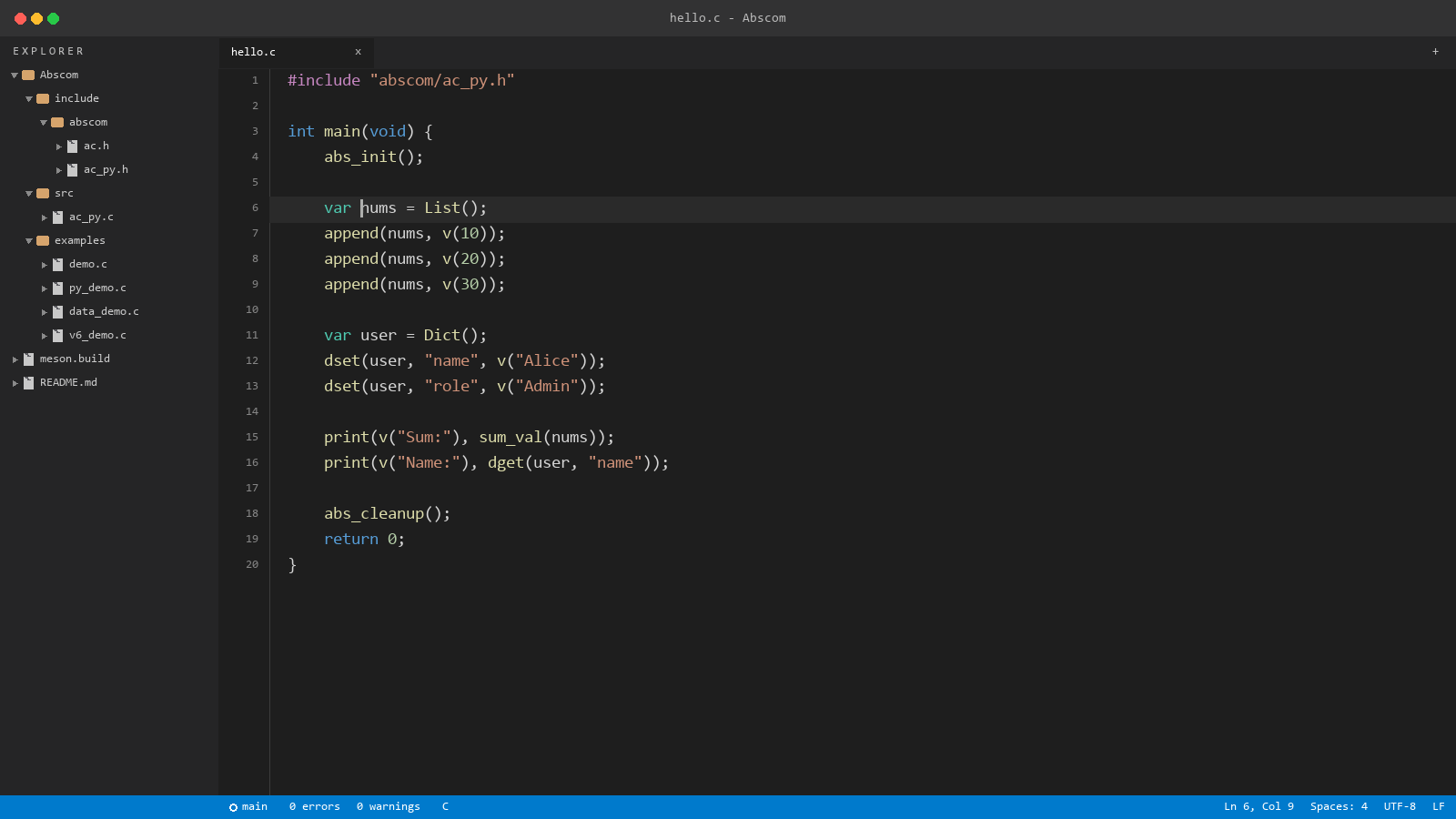
Quick start — the dynamic runtime in a few lines of C.
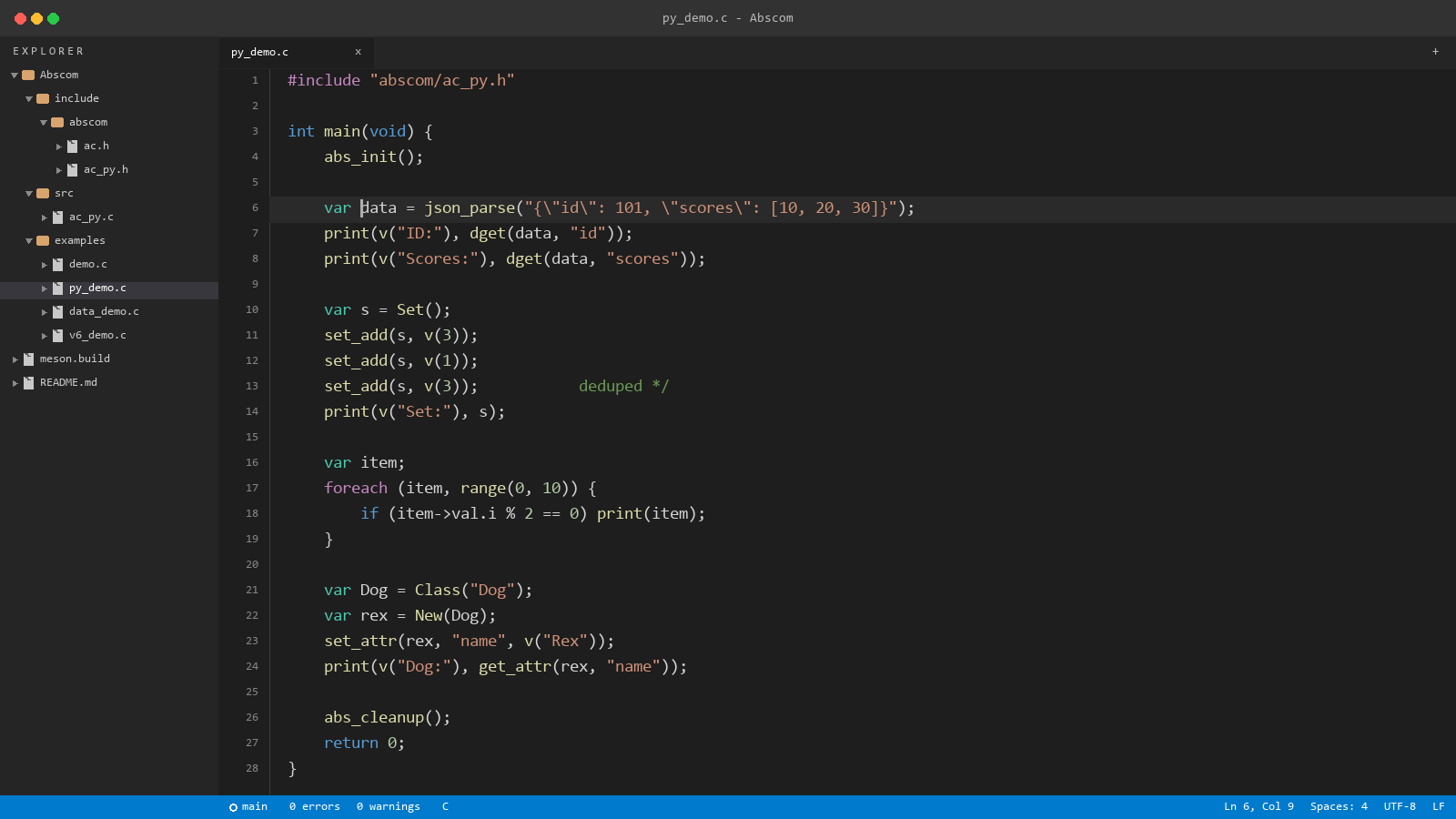 Dynamic runtime |
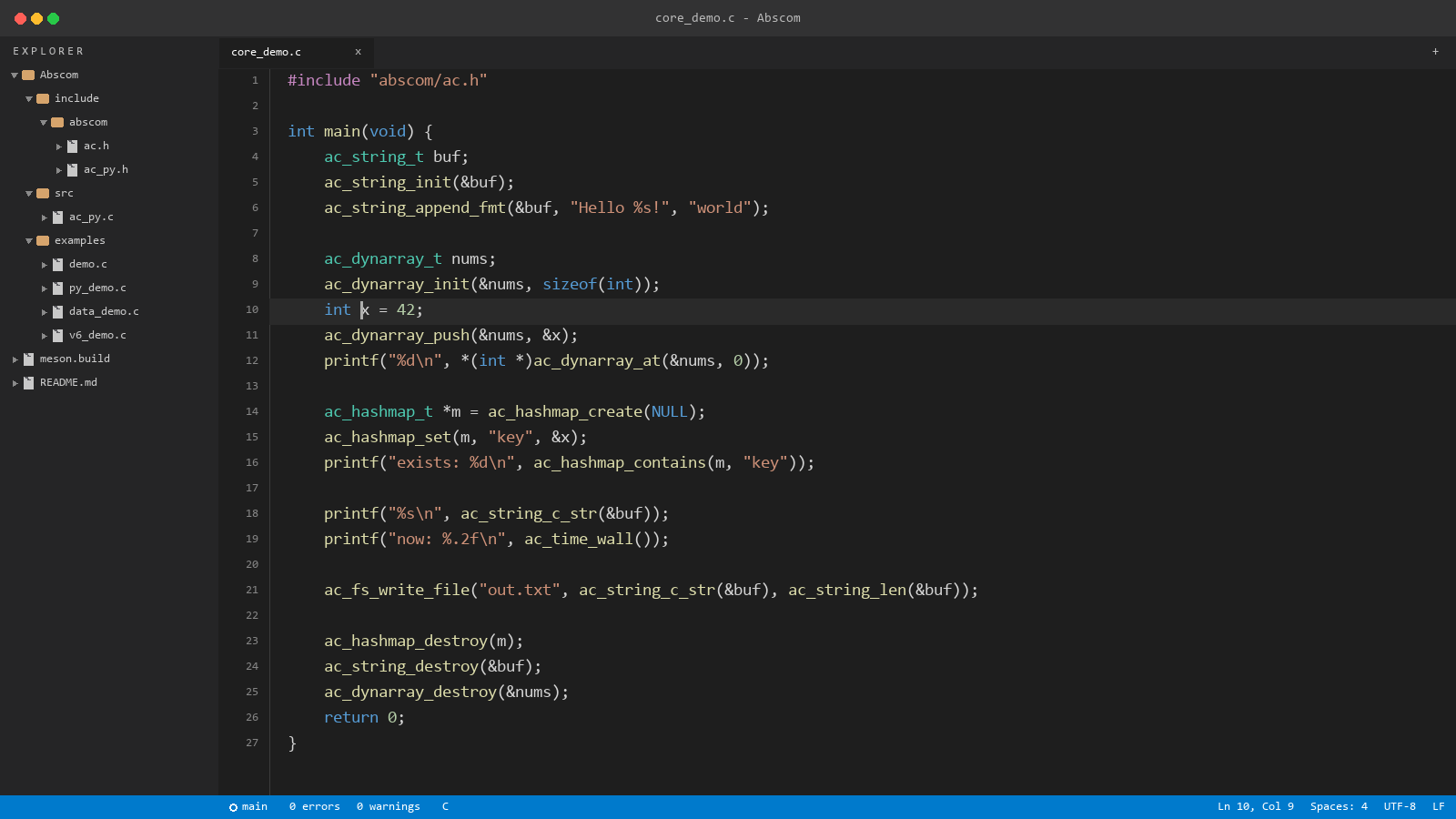 Core modules |
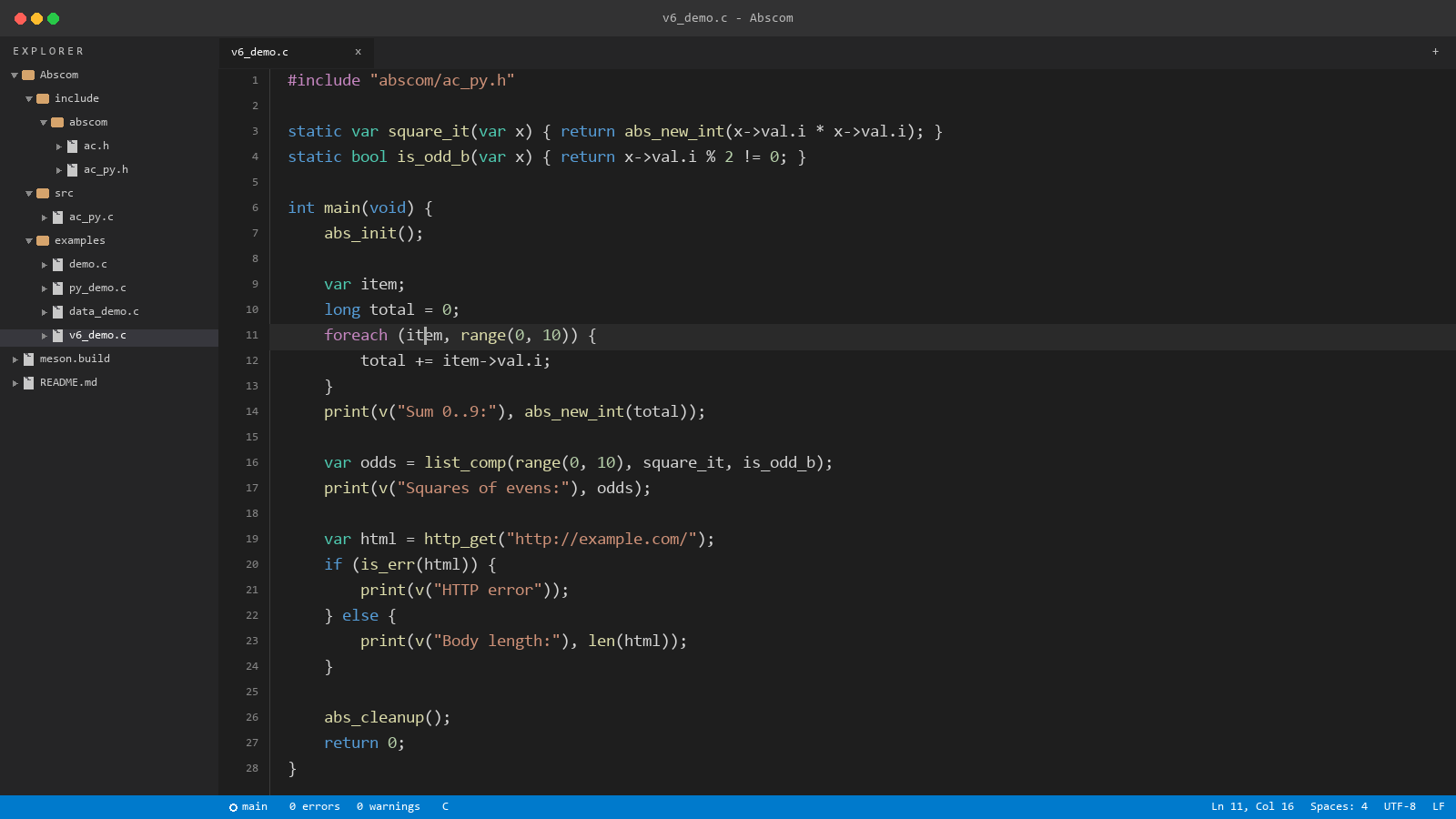 Example program |
More: View all screenshots
- Key Features
- Installation
- Quick Start
- Usage Examples
- Documentation
- Interface
- Architecture
- Requirements
- Prerequisites
- Development
- Contributing
- Security
- License
- Zero-dependency C11 library — only the standard library, plus
ws2_32on Windows forhttp_get. - Data structures — dynamic array (
abs_dynarray), growable string (abs_string), and an open-addressing, string-keyed hash map (abs_hashmap) with tombstone deletion and automatic resizing. - Hashing — FNV-1a 32/64-bit and djb2 hash functions (
abs_hash). - Platform helpers — monotonic/wall-clock time (
abs_time) and file existence/read/write/remove/rename (abs_fs). - Python-inspired runtime —
varobjects created with thev()literal macro, plusNone/True/False. - Containers — lists, dictionaries, and deduplicating sets with union/difference/contains operations.
- Strings — split/join, strip, case conversion,
startswith/endswith, andcount. - JSON —
json_parse(objects, arrays, numbers, booleans, null, nested values) andjson_dumpwith full escaping. - Functional helpers —
map_func,filter_func, andlist_comp(map + filter in one pass). - Random utilities —
randint,random_float,uniform,choice,choices,sample,shuffle, and seeded/seed()sequences. - Aggregates & math —
min_val,max_val,sum_val,abs_val,pow_val,round_val. - Sequences —
sorted(ascending/descending),reversed_seq,zip_lists,slice, andrange/range_step. - OOP-lite —
Class/New/set_attr/get_attrfor lightweight class-and-instance objects. - System helpers —
sleep_sec,time_now,exec_cmd, and an HTTP/1.0http_get. - Matrices —
abs_matrix_*constructors, get/set, add/sub/scale, Hadamard (mul_element), deepcopy, scalar add, broadcasting (add_row_vector), element-wiseapply, multiplication, transpose, determinant, sum/mean/min/max reductions,argmax, and printing. - Statistics —
mean,median,mode, populationvariance, and populationstdev. - Advanced math —
sin_val,cos_val,tan_val,log_val,log10_val,sqrt_val,deg2rad, and theABS_PI/ABS_E/ABS_SQRT2/ABS_PHIconstants. - General math — scalar utilities (
abs_sq,abs_cb,abs_clamp,abs_lerp,abs_eq), number theory (abs_gcd,abs_lcm,abs_factorial,abs_is_prime,abs_fibonacci), geometry (abs_rad2deg,abs_hypot,abs_dist_euclidean,abs_dist_manhattan), a Newton-Raphsonabs_root_find, raw-array statistics (abs_stat_mean/median/variance/stddev), and complex numbers (abs_c_add/sub/mul,abs_c_mag,abs_c_conj,abs_c_print). - Data science — NumPy-style shapes (
abs_matrix_reshape/flatten/slice/vstack/hstack), generators (abs_matrix_ones,arange,linspace,eye), Pandas-style numeric CSV (abs_matrix_read_csv/write_csv), functional utils (abs_matrix_map,abs_matrix_filter), SciKit-Learn-style preprocessing (abs_matrix_one_hot_encode,abs_matrix_train_test_splitreturning[X_train, X_test, Y_train, Y_test]), and the Pythonicprint_mat/foreach_matmacros. - Ultimate layer — computational backends (
abs_set_backendoverABS_CPU/ABS_CPU_AVXSIMD /ABS_GPU_CUDAstub) thatabs_matrix_muldispatches on, a Micrograd-style scalar autograd engine (abs_scalar_new/add/mul/relu/sigmoidwithabs_scalar_backward), PPM image loading and saving with 2D convolution (abs_img_load_ppm/save_ppm/conv2d), ASCII and SVG plotting (abs_plot_ascii/abs_plot_svg), and a mixed-type DataFrame (abs_df_create,abs_df_add_col_double/_string,abs_df_print,abs_df_free). - Spatial math — modern type aliases (
i8/i16/i32/i64/isize,u8/u16/u32/u64/usize,f32/f64,b8/b32,byte), anonymous-union vectors (vec2/vec3/vec4,ivec2/ivec3/ivec4,vec2d/vec3d/vec4d) withx/y/zandr/g/b/aaliases, column-majormat2/mat3/mat4, and quaternions — all plain value types (abs_v2_*/abs_v3_*/abs_v4_*,abs_quat_*,abs_mat4_*). - Macro utilities —
ABS_MIN/MAX/MIN3/MAX3/MIN4/MAX4,ABS_ABS/SIGN/CLAMP/CLAMP01/IN_RANGE,ABS_SQR/CUBE/DIFF/APPROX_EQ, interpolation and shading (ABS_LERP/UNLERP/REMAP/STEP/SMOOTHSTEP),ABS_DEG2RAD_M/RAD2DEG_M,ABS_ARRAY_LEN/OFFSETOF/CONTAINER_OF, genericABS_SWAP(+ABS_SWAP_Tfallback), bitwise (ABS_BIT,ABS_BIT_SET/CLEAR/TOGGLE/CHECK,ABS_IS_POW2,ABS_ALIGN_UP/DOWN), AI activations (ABS_RELU_M/LEAKY_RELU_M/HEAVISIDE_M), plus guard-checked unprefixed aliases (MIN,MAX,CLAMP,LERP,REMAP,SIGN,SQR,ARRAY_LEN,SWAP,DEG2RAD,RAD2DEG,BIT,IS_POW2). - AI/ML —
sigmoid/relu/tanhactivations with backprop-ready derivatives (abs_diff_*), row-wiseabs_matrix_softmax,abs_loss_mse, classificationabs_accuracy, and a central-differenceabs_gradfor numerical gradients, plusabs_matrix_randomweight initialization. - Combinatorics —
factorial,nCr,nPr(var) andabs_factorial,abs_nCr,abs_nPr(plain C ints). - Paths & OS helpers —
path_join,path_exists,getcwd_val. - CSV —
csv_readandcsv_write. - Threading —
thread_start/thread_joinwith a lock-guarded object pool for safe allocation from worker threads. - Exceptions —
try/catch/end_try+throw, withwith(VAR, INIT)context managers andclose_resourcefor automatic cleanup. - Regex —
re_match,re_findall, andre_subwith./*/^/$support. - Date & time —
datetime_now,strftime_val, andtimedelta. - Generators — lazy
range_gen/nextsequences. - Encoding & env —
base64_encode, version-4uuid4, andos_getenv/os_setenv. - Web server —
Server/route/server_runmicro HTTP server plus a socket-freeserver_handledispatcher for testing. - Events —
EventBus/on/emitpublish-subscribe with per-event handler lists. - Plugins —
load_library/call_lib_funcdynamic library loading (LoadLibrary/dlopen). - Function objects —
make_funcand nameddef(f, name),call_funcdispatch,memoize/call_memoizedcaching,decoratebody-swapping, and target-awaredecorate_func(target, wrapper)decorators that wrap pre/post logic around the original (Python@decoratorstyle) withfunc_meta/func_nameintrospection. - Introspection —
id,repr, anddirfor object identity, debugging, and key listing. - Itertools — lazy
chainandcycleiterators withiter_next. - Sorting suite — twelve algorithms from
O(n²)(bubble, selection, insertion) toO(n log n)(shell, heap, merge, quick, Cqsort) andO(n)integer sorts (counting, radix, bucket), plus the jokesort_bogo. - Visualizer —
sort_bubble_visualcalls anAbsSortVishook on every swap for logs or animations. - Benchmarking —
timeittimes any sort on a deep-copied list without touching the original. - Search —
binary_searchfor sorted lists, plusis_sortedandlist_copyhelpers. - WebSockets — RFC 6455
ws_accepthandshake (real SHA-1),ws_send/ws_recvtext framing, and publicws_compute_accept/ws_encode_frame/ws_decode_framehelpers for testing the wire format socket-free. - Cryptography — from-scratch
sha256andhmac_sha256(FIPS 180-4 / RFC 2104), pinned to known-answer test vectors. - More shuffling —
fisher_yates(the classic name forshuffle) and a card-deckriffle_shufflethat cuts and interleaves the list. - Iterators —
chain,cycle, andrepeatconsumed viaiter_next. - One umbrella header —
abscom/abs.hexposes the core modules and the dynamic runtime.
The quickest way to install Abscom is the one-line installer. It downloads a prebuilt release asset for your platform (from the automatic release pipeline) and installs the headers, libraries, and pkg-config file to a prefix — no compiler needed. When no matching prebuilt asset is available it falls back to downloading the source and building it with Meson (or a direct cc/gcc compile). The same script uninstalls everything it placed.
Windows (PowerShell):
irm https://raw.githubusercontent.com/rkriad585/Abscom/main/installer.ps1 | iexLinux and macOS:
curl -fsSL https://raw.githubusercontent.com/rkriad585/Abscom/main/installer.sh | shUninstall with the same command plus the uninstall flag:
(Invoke-RestMethod https://raw.githubusercontent.com/rkriad585/Abscom/main/installer.ps1) + " -SelfUninstall" | iexcurl -fsSL https://raw.githubusercontent.com/rkriad585/Abscom/main/installer.sh | sh -s -- --selfuninstallPass -Prefix <dir> (PowerShell) or --prefix <dir> (Unix) to install to another location, and -ForceDirect / --force-direct to skip Meson. See docs/installation.md for options.
Requires a C11 compiler, Meson, and Ninja.
git clone https://github.com/rkriad585/Abscom.git
cd Abscom
./build.sh                          # configure, build, and run the tests
./build.sh --install --prefix "$HOME/.local"
On Windows:
git clone https://github.com/rkriad585/Abscom.git
cd Abscom
.\build.ps1
.\build.ps1 -Install -Prefix "$HOME\abscom"
The raw Meson commands work too: meson setup build, meson compile -C build, meson test -C build, and meson install -C build. On Windows the build automatically links the Winsock library (ws2_32) that http_get needs; no manual steps are required.
Compile against the installed library, or let pkg-config supply the flags:
export PKG_CONFIG_PATH=<prefix>/lib/pkgconfig
cc -std=c11 hello.c $(pkg-config --cflags --libs abscom) -o hello
See docs/installation.md for platform notes.
Save the following as hello.c:
#include "abscom/abs.h"

int main(void) {
    abs_init();

    var nums = List();
    append(nums, v(10));
    append(nums, v(20));
    append(nums, v(30));
    print(v("Sum:"), sum_val(nums));

    var user = Dict();
    dset(user, "name", v("Alice"));
    print(v("Name:"), dget(user, "name"));

    abs_cleanup();
    return 0;
}
Build and run it against the static library:
cc -std=c11 hello.c -Iinclude build/libabscom.a -o hello
./hello
On Windows, add -lws2_32. If you installed Abscom with the installer instead of building it, use pkg-config (see Installation). Expected output:
Sum: 60
Name: Alice
See docs/getting-started.md for a longer walkthrough.
var s = Set();
set_add(s, v(3));
set_add(s, v(1));
set_add(s, v(3));          /* duplicate, ignored */
print(v("Set:"), s);       /* {3, 1} */

var item;
long total = 0;
foreach (item, range(0, 10)) total += item->val.i;
print(v("foreach sum:"), abs_new_int(total));   /* 45 */

/* square_it and is_odd_b are user callbacks (see examples/v6_demo.c) */
print(v("Squares:"), list_comp(range(0, 10), square_it, is_odd_b));var data = json_parse("{\"id\": 101, \"scores\": [10, 20, 30]}");
print(v("ID:"), dget(data, "id"));
var out = json_dump(data);
print(out); /* {"id": 101, "scores": [10, 20, 30]} */var Dog = Class("Dog");
var rex = New(Dog);
set_attr(rex, "name", v("Rex"));
print(v("Name:"), get_attr(rex, "name")); /* Rex */var html = http_get("http://example.com/");
if (is_err(html)) {
print(v("HTTP error:"), html);
} else {
print(v("Body length:"), len(html));
}var A = abs_matrix_new(2, 2);
abs_matrix_set(A, 0, 0, 1.0); abs_matrix_set(A, 0, 1, 2.0);
abs_matrix_set(A, 1, 0, 3.0); abs_matrix_set(A, 1, 1, 4.0);
print(v("det(A):"), abs_matrix_det(A)); /* -2.00 */
var data = List();
append(data, v(10)); append(data, v(20));
append(data, v(20)); append(data, v(40));
print(v("mean:"), abs_stats_mean(data)); /* 22.50 */
print(v("stdev:"), abs_stats_stdev(data));/* 10.90 */static var square(var x) {
return abs_new_float(abs_num_val(x) * abs_num_val(x));
}
var X = abs_matrix_random(3, 2); /* batch of 3 samples */
var W1 = abs_matrix_random(2, 4); /* 2 -> 4 hidden neurons */
var W2 = abs_matrix_random(4, 1);
var Z1 = abs_matrix_mul(X, W1);
abs_matrix_apply(Z1, abs_act_sigmoid); /* hidden activation */
var Z2 = abs_matrix_mul(Z1, W2);
abs_matrix_apply(Z2, abs_act_relu); /* output predictions */
print(abs_loss_mse(Y_true, Z2)); /* mean squared error */
print(abs_grad(square, abs_new_float(3.0))); /* 6.00 */var Z1 = abs_matrix_mul(X, W1);
abs_matrix_add_row_vector(Z1, b1); /* broadcast the bias in */
var A1 = abs_matrix_copy(Z1);
abs_matrix_apply(A1, abs_act_sigmoid);
var Y_pred = ...;
var Error = abs_matrix_sub(Y_pred, Y_true);
var delta2 = abs_matrix_mul_element(Error,
abs_matrix_apply_deriv(Y_pred, abs_diff_sigmoid));
var dW2 = abs_matrix_mul(abs_matrix_transpose(A1), delta2);
var W2_new = abs_matrix_sub(W2, abs_matrix_scale(dW2, 0.1)); /* SGD */
print(abs_accuracy(Y_true, Y_pred)); /* classification accuracy */var g = range_gen(0, 6, 2);
var n;
while ((n = next(g)) != NULL && !is_none(n)) print(n); /* 0 2 4 */
print(re_sub(v("o"), v("0"), v("hello"))); /* hell0 */
var result = None;
try {
if (1 < 0) throw("impossible");
result = v(42);
}
catch (result) { print(v("Caught:"), result); }
end_try;
print(v("Result:"), result); /* 42 */static var api_home(var req) { (void)req; return v("<h1>Home</h1>"); }
var app = Server(0); /* ephemeral port */
route(app, "/", api_home);
print(server_handle(app, "GET / HTTP/1.1")); /* <h1>Home</h1> */
/* server_run(app); /* blocking HTTP server */
var bus = EventBus();
on(bus, "login", my_login_handler);
emit(bus, "login", v("Alice"));
var f = memoize(heavy_calc); /* cached calls */
print(call_memoized(f, v(5)));
static var timing(var target, var args) { /* @decorator in C */
var r = call_func(target, args); /* run the original */
return r;
}
var sq = def(slow_square, "square"); /* named function */
var timed = decorate_func(sq, timing); /* wrap it */
print(call_func(timed, v(4))); /* 16 */
print(func_name(timed)); /* square */
var c = chain(List(), List()); /* itertools */
print(iter_next(c)); /* None once exhausted */static void on_swap(var list, int idx_a, int idx_b) {
(void)idx_a; (void)idx_b;
print(list); /* log every step */
}
var data = List();
for (int i = 0; i < 100; i++) append(data, v(rand() % 1000));
print(v("bubble took:"), v(timeit(sort_bubble, data)), v("sec"));
var small = List();
append(small, v(50)); append(small, v(10)); append(small, v(40));
sort_bubble_visual(small, on_swap); /* [10, 40, 50] */
sort_quick(data); /* in place */
print(v("Found at index:"), v(binary_search(data, v(500))));var h = sha256("password"); /* 5e884898... */
print(h);
print(hmac_sha256("secret", "message"));
print(ws_compute_accept("dGhlIHNhbXBsZSBub25jZQ==")); /* s3pPLMBiTxaQ9kYGzzhZRbK+xOo= */
char frame[32], out[32];
size_t n = ws_encode_frame(frame, sizeof(frame), "Hello"); /* 81 05 48 65 6c 6c 6f */
long len = ws_decode_frame(frame, n, out, sizeof(out)); /* 5 */
var deck = range(0, 13);
riffle_shuffle(deck); /* cut and interleave */
fisher_yates(deck); /* full randomization */
var rep = repeat(v("beep"), 3); /* repeat() iterator */
print(iter_next(rep)); /* beep */More examples live in the examples/ directory (demo.c, py_demo.c, data_demo.c, v6_demo.c, sci_demo.c, lang_demo.c, framework_demo.c, sort_demo.c, crypto_demo.c, ml_demo.c, ml_train_demo.c, math_demo.c, ds_demo.c, ultra_demo.c, geom_demo.c, demo_macros.c) and are built as build/examples/<name>.
| Document | Description |
|---|---|
| docs/getting-started.md | First steps, prerequisites, and a walkthrough. |
| docs/installation.md | Building, linking, and installing Abscom. |
| docs/architecture.md | Module layout and how the pieces fit together. |
| docs/configuration.md | Build-time options and the (empty) runtime config story. |
| docs/development.md | Building, testing, and releasing. |
| docs/deployment.md | Vendoring, installation layout, and distribution. |
| docs/screenshots.md | Screenshot index. |
| docs/faq.md | Frequently asked questions. |
| docs/troubleshooting.md | Common build and runtime problems. |
| Document | Description |
|---|---|
| common-macros.md | ABS_API, C++ interop, and ABS_UNUSED. |
| macros.md | Numeric, interpolation, bitwise, alignment, struct, and AI activation macros. |
| dynamic-arrays.md | abs_dynarray — generic dynamic array. |
| strings.md | abs_string — growable NUL-terminated string. |
| hashing.md | abs_hash — FNV-1a and djb2. |
| hash-maps.md | abs_hashmap — open-addressing string-keyed map. |
| time.md | abs_time — monotonic and wall-clock timers. |
| file-io.md | abs_fs — file existence, read/write, remove, rename. |
| Document | Description |
|---|---|
| lifecycle.md | abs_init, abs_cleanup, del, and the memory pool. |
| literals-and-constructors.md | v(), None/True/False, List/Dict/Set. |
| types-and-conversions.md | AbsType, type(), is_*, to_str/to_int/to_float. |
| lists-and-ranges.md | append, get, len, range, range_step, slice. |
| loops.md | The foreach macro. |
| dictionaries.md | dset/dget and keyed lookups. |
| sets.md | set_add, set_contains, set_union, set_diff. |
| string-methods.md | upper/lower, split/join, strip, startswith/endswith, count. |
| formatting.md | print, print_end, fmt, input, and stringification. |
| json.md | json_parse and json_dump. |
| functional-helpers.md | map_func, filter_func, list_comp. |
| random-utilities.md | seed, randint, choice, sample, shuffle, and more. |
| math-and-aggregates.md | min_val/max_val/sum_val, abs_val, pow_val, round_val. |
| truthiness-and-logic.md | is_true, not_, any, all, eq. |
| sequences-and-sorting.md | sorted, reversed_seq, zip_lists. |
| oop-lite.md | Class / New / set_attr / get_attr. |
| runtime-files.md | fopen_safe, read_file, write_file, close_file. |
| system.md | sleep_sec, time_now, exec_cmd, http_get. |
| error-handling.md | abs_new_error, is_err, and failure behavior. |
| Document | Description |
|---|---|
| scientific.md | Matrices, statistics, advanced math, combinatorics, paths, CSV, and threading. |
| ml.md | Activations and derivatives, broadcasting, softmax, loss, accuracy, and numerical gradients for neural networks. |
| general-math.md | Scalar math helpers, number theory, geometry, root finding, complex numbers, and raw-array statistics. |
| data-science.md | NumPy-style reshaping and generators, Pandas-style CSV, functional utils, and SciKit-Learn-style preprocessing. |
| ultimate.md | Computational backends (AVX/GPU), scalar autograd, PPM vision and convolution, plotting, and dataframes. |
| spatial-math.md | Modern type aliases, 2D/3D/4D vectors, mat4, and quaternions. |
| Document | Description |
|---|---|
| exceptions.md | try/catch/end_try, throw, and with context managers. |
| regex.md | re_match, re_findall, and re_sub. |
| datetime.md | datetime_now, strftime_val, and timedelta. |
| generators.md | range_gen and next. |
| encoding-and-env.md | base64_encode, uuid4, os_getenv, and os_setenv. |
| Document | Description |
|---|---|
| web-server.md | Server, route, server_handle, and server_run. |
| events.md | EventBus, on, and emit. |
| plugins.md | load_library and call_lib_func. |
| functions.md | make_func, def, call_func, memoize, decorate/decorate_func, func_meta, func_name. |
| introspection.md | id, repr, and dir. |
| itertools.md | chain, cycle, and iter_next. |
| Document | Description |
|---|---|
| sorting.md | Twelve sorting algorithms, sort_bubble_visual, timeit, and binary_search. |
| Document | Description |
|---|---|
| websockets.md | RFC 6455 ws_accept, ws_send, ws_recv, and the framing helpers. |
| crypto.md | sha256 and hmac_sha256 (FIPS 180-4 / RFC 2104). |
- Core library — include
<abscom/abs.h>to getabs_dynarray,abs_string,abs_hash,abs_hashmap,abs_time, andabs_fsin one header. - Dynamic runtime — include
<abscom/abs.h>for the Python-inspiredvarAPI. - ABI/export macros —
ABS_APIcontrols__declspec(dllexport/dllimport)on Windows and default visibility on GCC/Clang (abs_common.h). - The library is built as both a static library and a shared library by default (
both_librariesin Meson).
graph TD
    subgraph core["abscom core (src/, include/abscom/)"]
        common[abs_common.h - API / ABI macros]
        dyn[abs_dynarray - dynamic array]
        str[abs_string - growable string]
        hash[abs_hash - FNV-1a / djb2]
        map[abs_hashmap - open-addressing map]
        time[abs_time - monotonic / wall clock]
        fs[abs_fs - file I/O]
        rt[abs - Python-like runtime]
        sci[abs_* - matrices, stats, math, CSV, paths, threads]
        ml[abs_ml - activations, loss, gradients]
        lang[abs_except, abs_regex, abs_datetime, abs_gen, abs_encode, abs_env - language features]
        fw[abs_server, abs_events, abs_plugins, abs_func, abs_introspect, abs_itertools - framework]
        algo[abs_sort - sorting, benchmarking, binary search]
        rt2[abs_crypto, abs_ws - SHA-256 / HMAC, WebSockets]
    end

    subgraph users["Consumers"]
        tests[tests/test_* - Meson test suite]
        examples[examples/* - demo programs]
    end

    dyn --> common
    str --> common
    hash --> common
    map --> hash
    time --> common
    fs --> common
    rt --> str
    sci --> rt
    ml --> sci
    lang --> rt
    fw --> rt
    algo --> rt
    rt2 --> rt
    tests --> core
    examples --> core
See docs/architecture.md for the full layout.
- A C11 compiler (GCC, Clang, or MSVC-compatible).
- Meson (tested with 1.x) and Ninja for building from source.
- Windows builds link
ws2_32; POSIX builds use the standard socket andclock_gettimeinterfaces. - POSIX builds also link
mandpthreadfor the scientific layer's math and threading. - Linux builds link
dlfor the plugin loader (dlopen/dlsym); macOS provides it through libSystem. - No third-party C library dependencies.
- Linux/macOS: a C toolchain plus Meson and Ninja.
- Windows: a MinGW toolchain (e.g. LLVM MinGW) or MSVC, plus Meson and Ninja; the generated build handles
ws2_32automatically.
git clone https://github.com/rkriad585/Abscom.git
cd Abscom
./build.sh            # or .\build.ps1 on Windows
build.sh / build.ps1 wrap meson setup, meson compile, and meson test, and accept --clean, --buildtype, --skip-tests, --install, and --prefix (-Clean, -BuildType, -SkipTests, -Install, -Prefix in PowerShell). The equivalent raw commands:
meson setup build
meson compile -C build
meson test -C build
Run the example programs:
./build/examples/demo
./build/examples/py_demo
./build/examples/data_demo
./build/examples/v6_demo
./build/examples/sci_demo
./build/examples/lang_demo
./build/examples/framework_demo
./build/examples/sort_demo
./build/examples/crypto_demo
./build/examples/ml_demo
./build/examples/ml_train_demo
./build/examples/math_demo
./build/examples/ds_demo
./build/examples/ultra_demo
./build/examples/geom_demo
./build/examples/demo_macros
See docs/development.md for details.
Contributions are welcome. Please read CONTRIBUTING.md first, and note the Code of Conduct.
Please report security issues responsibly. See SECURITY.md for the supported versions and reporting policy.
Abscom is released under the MIT License.