


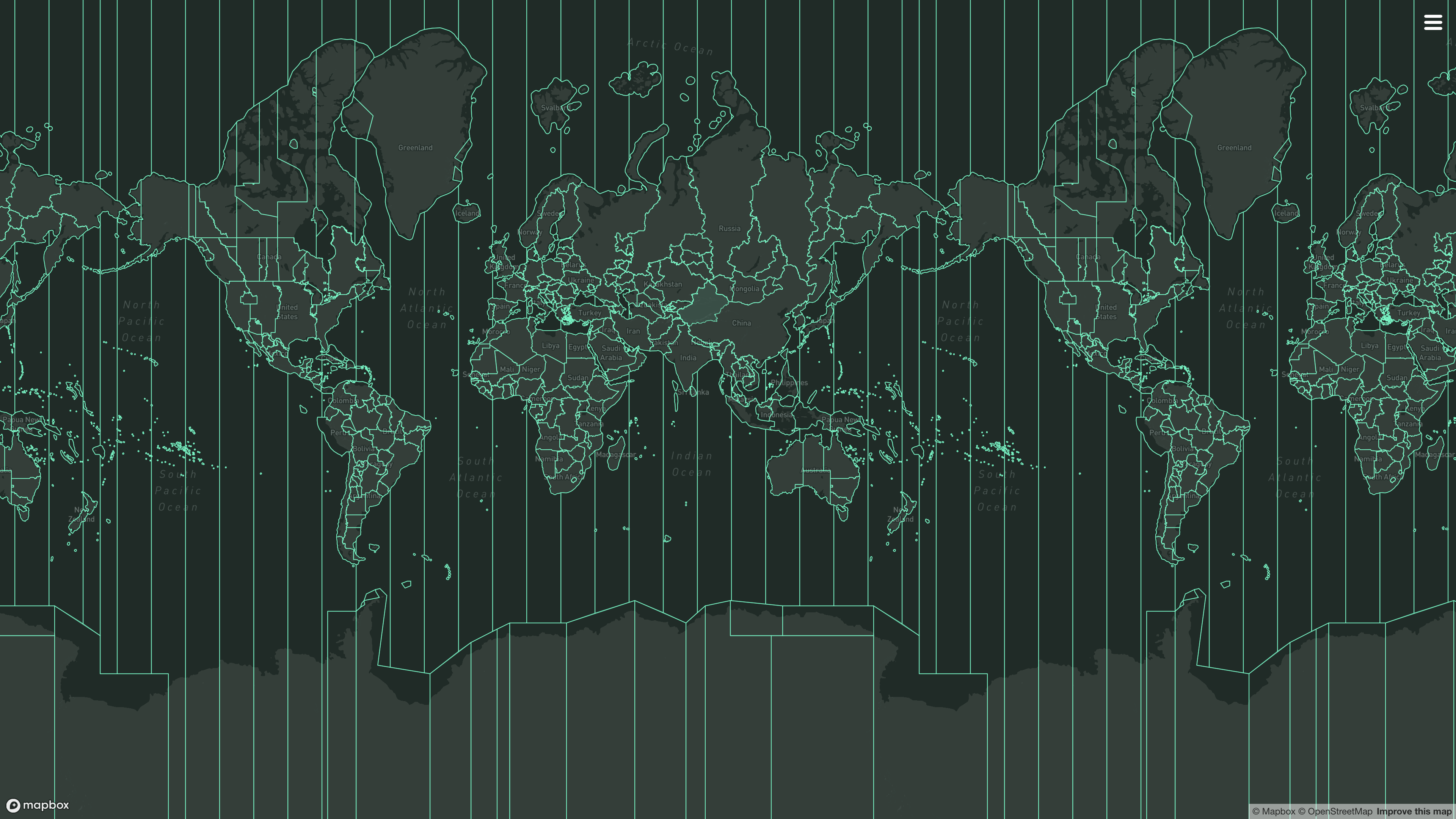
- Released documentation: https://pkg.go.dev/github.com/ringsaturn/tzf
- Try it online: tzf-web
Install via:
go get github.com/ringsaturn/tzfNote
This NewDefaultFinder uses simplified shape data so it is not entirely
accurate around the border, but the error is small and bounded: every
simplified boundary stays within ~111 m of the full-precision border. See
Accuracy for measured numbers.
It's expensive to init tzf's Finder/FuzzyFinder/DefaultFinder, please consider reuse it or as a global var. Below is a global var example:
package main

import (
	"fmt"

	"github.com/ringsaturn/tzf"
)

var f tzf.F

func init() {
	var err error
	f, err = tzf.NewDefaultFinder()
	if err != nil {
		panic(err)
	}
}

func main() {
	// In longitude-latitude order
	fmt.Println(f.GetTimezoneName(116.3883, 39.9289))
	fmt.Println(f.GetTimezoneName(-73.935242, 40.730610))
}If you require a query result that is 100% accurate, use the following to locate(also, reuse it when possible):
package main

import (
	"fmt"

	"github.com/ringsaturn/tzf"
)

func main() {
	finder, err := tzf.NewFullFinder()
	if err != nil {
		panic(err)
	}

	fmt.Println(finder.GetTimezoneName(139.6917, 35.6895))
}
Please note that NewFullFinder() is more expensive to init and has higher
memory usage than NewDefaultFinder(), but it provides 100% accuracy.
See the Performance section for more details.
In addition to using tzf as a library in your Go projects, you can also use the tzf command-line interface (CLI) tool to quickly get the timezone name for a set of coordinates. To use the CLI tool, you first need to install it using the following command:
go install github.com/ringsaturn/tzf/cmd/tzf@latestOnce installed, you can use the tzf command followed by the latitude and longitude values to get the timezone name:
tzf -lng 116.3883 -lat 39.9289Alternatively if you want to look up multiple coordinates efficiently you can specify the ordering and pipe them to the tzf command one pair of coordinates per line:
echo -e "116.3883 39.9289\n116.3883, 39.9289" | tzf -stdin-order lng-latYou can download the original data from https://github.com/evansiroky/timezone-boundary-builder.
The preprocessed protobuf data can be obtained from
https://github.com/ringsaturn/tzf-dist, which has Go's embedded support.
These files are Protocol Buffers messages for more efficient binary
distribution. You can view the pb/tzinfo.proto file or
its HTML format documentation for information about the internal
format.
The data pipeline for tzf can be illustrated as follows:
graph TD
    Raw[GeoJSON from evansiroky/timezone-boundary-builder]
    Full[Timezones .bin ~92MB]
    Simplified[Timezones .topology.bin ~13MB<br/>topology-aware simplified]
    SimplifiedTopo[TopoTimezones .topology.topo.bin ~10MB]
    FullTopo[TopoTimezones .topo.bin ~52MB]
    SimplifiedCompressTopo[CompressedTopoTimezones<br/>.topology.compress.topo.bin ~5.4MB]
    FullCompressTopo[CompressedTopoTimezones<br/>.compress.topo.bin ~17MB]
    Preindex[PreindexTimezones<br/>.topology.preindex.bin ~2MB]

    Finder[Finder: Polygon Based Finder]
    FuzzyFinder[FuzzyFinder: Tile based Finder]
    DefaultFinder[DefaultFinder: FuzzyFinder + Finder fallback]

    Raw --> |cmd/geojson2tzpb|Full
    Full --> |cmd/reducetzpb -topology|Simplified
    Full --> |cmd/deduplicatetzpb|FullTopo
    FullTopo --> |cmd/compresstopotzpb|FullCompressTopo
    Simplified --> |cmd/deduplicatetzpb|SimplifiedTopo
    SimplifiedTopo --> |cmd/compresstopotzpb|SimplifiedCompressTopo
    Simplified --> |cmd/preindextzpb|Preindex

    FullCompressTopo --> |tzf.NewFinderFromCompressedTopo|Finder
    SimplifiedCompressTopo --> |tzf.NewFinderFromCompressedTopo|Finder
    Preindex --> |tzf.NewFuzzyFinderFromPB|FuzzyFinder
    SimplifiedCompressTopo --> |tzf.NewDefaultFinder|DefaultFinder
    Preindex --> |tzf.NewDefaultFinder|DefaultFinder
    FullCompressTopo --> |tzf.NewFullFinder|DefaultFinder
    Preindex --> |tzf.NewFullFinder|DefaultFinder
The combined-with-oceans.compress.topo.bin (~17MB) preserves full geometric
precision with shared-edge deduplication and polyline compression. Use
NewFullFinder() to load it.
The combined-with-oceans.topology.compress.topo.bin (~5.4MB) applies
topology-aware Douglas-Peucker simplification (~85% point reduction) before
deduplication and compression. It is used by the default NewDefaultFinder()
and may not be perfectly accurate at some border areas; the deviation is
bounded to ~111 m (see Accuracy).
The combined-with-oceans.topology.preindex.bin (~2MB) consists of multiple map
tiles and is used within both DefaultFinder and FullFinder as the fast-path
FuzzyFinder, handling most queries without polygon ray-casting.
I have written an article about the history of tzf, its Rust port, and its Rust port's Python binding; you can view it here.
The Douglas-Peucker simplification uses an epsilon of 0.001 degrees, which
caps boundary displacement at roughly 111 m by construction. Measured against
the full-precision 2026c dataset with internal/cmd/borderchange (spherical
model, certified via Lipschitz interval subdivision):
| Metric | Result |
|---|---|
| Certified maximum boundary displacement | 111.2 m (+1.0 m tolerance) |
| Boundary length displaced more than 100 m | 0.41% |
| Boundary length displaced more than 500 m | 0% |
| Total mis-assigned area | 16,828 km² (~0.003% of Earth) |
| Mis-assigned area within 100 m of the true border | 92.8% |
In other words, only queries that land within ~111 m of a timezone border can
ever differ from the full-precision result, and most of that band is far
narrower. If your use case is sensitive inside that band, use
NewFullFinder().
Verify the accuracy yourself by running the following commands:
gh release download v0.0.2026-c-fix1 --repo ringsaturn/tzf-dist \
  --pattern "combined-with-oceans.compress.topo.bin"

go run ./internal/cmd/topodecode \
  combined-with-oceans.compress.topo.bin combined-with-oceans.dist.bin

go run ./internal/cmd/borderchange \
  -epsilon 0.001 \
  -certification-tolerance-m 0.5 \
  -top-pairs 20 \
  combined-with-oceans.dist.bin > BORDER_CHANGE.md
Output like:
➜  tzf git:(main) ✗ go run ./internal/cmd/borderchange \
  -epsilon 0.001 \
  -certification-tolerance-m 0.5 \
  -top-pairs 20 \
  combined-with-oceans.dist.bin > BORDER_CHANGE.md
2026/07/13 10:46:00 borderchange: dataset loaded in 441ms
2026/07/13 10:46:15 borderchange: simplification finished in 14.276s
2026/07/13 10:46:16 borderchange: 532881 arcs collected, analyzing with 16 workers
More details: BORDER_CHANGE.md.
The tzf package is intended for high-performance geospatial query backend services, such as weather forecasting APIs. Most queries can be returned within a very short time, averaging around 1000 nanoseconds.
Here is what has been done to improve performance:
- Using the simplified dataset by default.
- Using pre-indexing to handle most queries takes approximately 500 nanoseconds.
- Using the internal
geompackage(fork of geojson) with a YStripes index (inspired by Josh Baker'stg's ) to verify whether a polygon contains a point. Also a grid-index to quickly find candidate polygons, inspired by Aaron Roney's rtz.
That's all. There are no black magic tricks inside the tzf package.
Below is a benchmark run on my MacBook Pro with Apple M3 Max:
| Target | Dataset | Scenario | Median (ns) | p99 (ns) | Approx throughput (ops/s) | Memory (MiB) |
|---|---|---|---|---|---|---|
| DefaultFinder | topology-simplified + preindex | edge case · GetTimezoneName | 583.0 | 1708.0 | 1439.3K | 31.90 |
| FuzzyFinder | preindex | edge case · GetTimezoneName | 250.0 | 500.0 | 2682.4K | 2.40 |
| Finder | topology-simplified | edge case · GetTimezoneName | 416.0 | 2291.0 | 1734.0K | 29.70 |
| FullFinder | full-precision + preindex | edge case · GetTimezoneName | 625.0 | 2083.0 | 1317.7K | 155.30 |
| Finder | full-precision | edge case · GetTimezoneName | 416.0 | 2000.0 | 1827.5K | 153.00 |
| DefaultFinder | topology-simplified + preindex | random world cities · GetTimezoneName | 208.0 | 959.0 | 3499.0K | 31.90 |
| FuzzyFinder | preindex | random world cities · GetTimezoneName | 208.0 | 416.0 | 3461.4K | 2.40 |
| Finder | topology-simplified | random world cities · GetTimezoneName | 292.0 | 1708.0 | 2275.8K | 29.70 |
| FullFinder | full-precision + preindex | random world cities · GetTimezoneName | 208.0 | 1542.0 | 3003.0K | 155.30 |
| Finder | full-precision | random world cities · GetTimezoneName | 291.0 | 1500.0 | 2498.8K | 153.00 |
| Finder | topology-simplified + GridIndex | random world cities · GetTimezoneName | 250.0 | 1459.0 | 2606.9K | 29.70 |
| Finder | topology-simplified (no GridIndex) | random world cities · GetTimezoneName | 2292.0 | 4208.0 | 473.0K | 24.00 |
| DefaultFinder | topology-simplified + preindex | random world cities · GetTimezoneNames | 625.0 | 3250.0 | 888.1K | 31.90 |
| FuzzyFinder | preindex | random world cities · GetTimezoneNames | 209.0 | 541.0 | 2751.8K | 2.40 |
| Finder | topology-simplified | random world cities · GetTimezoneNames | 542.0 | 2416.0 | 1377.6K | 29.70 |
| FullFinder | full-precision + preindex | random world cities · GetTimezoneNames | 583.0 | 2458.0 | 1312.9K | 155.30 |
- https://ringsaturn.github.io/tz-benchmark/ displays a continuous benchmark comparison with other packages.
| Language or Sever | Link | Note |
|---|---|---|
| Go | ringsaturn/tzf |
|
| Ruby | HarlemSquirrel/tzf-rb |
build with tzf-rs |
| Rust | ringsaturn/tzf-rs |
|
| Swift | ringsaturn/tzf-swift |
|
| Python | ringsaturn/tzfpy |
build with tzf-rs |
| HTTP API | racemap/rust-tz-service |
build with tzf-rs |
| JS via Wasm(browser only) | ringsaturn/tzf-wasm |
build with tzf-rs |
| Online | ringsaturn/tzf-web |
build with tzf-wasm |
See Project tzf for more information.
- https://github.com/paulmach/orb (used via the
ringsaturn/orb fork, which drops the
BSON/
mongo-driverdependency) - https://github.com/tidwall/geojson
- https://github.com/tidwall/tg
- https://github.com/jannikmi/timezonefinder
- https://github.com/evansiroky/timezone-boundary-builder
- And other projects listed in NOTICE
This project is licensed under the MIT license and
Anti CSDN License1. The data is licensed
under the
ODbL license,
same as
evansiroky/timezone-boundary-builder
Footnotes
-
This license is to prevent the use of this project by CSDN, has no effect on other use cases. ↩