


nisa = {
    "role":     "Software Engineer",
    "based":    "Türkiye 🇹🇷",
    "tracks":   ["retrieval-grounded AI", "production web systems"],

    "flagships": {
        "Anamnesis": "hospital assistant that answers only from what it retrieved",
        "Titulus":   "law practice portal — live, 2,468 articles, run by the client",
    },

    "stack": {
        "ai":       ["RAG", "tool-calling agents", "LLM APIs", "vector search"],
        "backend":  ["Python", "FastAPI", "PHP", ".NET", "SQLite"],
        "frontend": ["JavaScript", "React", "TypeScript", "PyQt6"],
        "signals":  ["OpenCV", "librosa", "Arduino", "ESP32", "C++"],
    },

    "rule":     lambda claim: claim if measurable(claim) else labelled(claim),
    "shipping": "systems that still run after I stop touching them",
}


Every number here is checkable in the repositories below. That is the point of the section.
STATUS |
SYSTEM |
WHAT IT DOES |
STACK |
|---|---|---|---|
| 🟢 LIVE | Titulus | Law practice portal in daily use. 2,468-article legislation library, daily Official Gazette feed, database-free admin panel the client runs himself. | PHP JS JSON Apache |
| 🧪 CI ✅ | Anamnesis | Hospital assistant that can only answer from what it retrieved. Clinical questions refused before the agent runs. No write path exists — a test proves it. | RAG agents FastAPI NumPy |
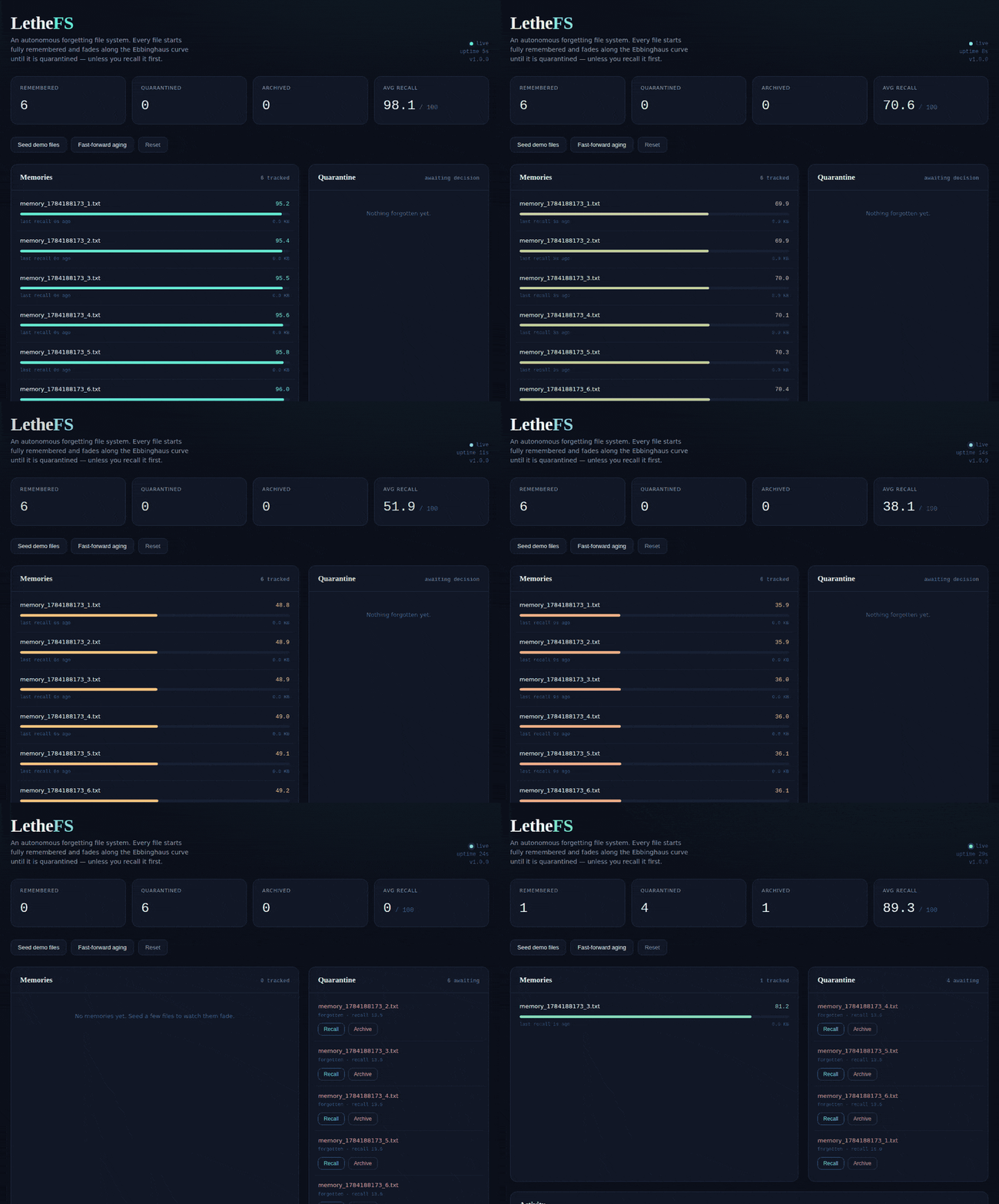
| 🧪 CI ✅ | LetheFS | Autonomous forgetting file system. Recall decays along the Ebbinghaus curve into a reversible quarantine. Nothing is deleted silently. | FastAPI WebSocket JS |
| 🧪 CI ✅ | Aurora | Live audio → pitch, timbre, loudness → a volumetric raymarching shader. Every session is a one-time piece. | librosa GLSL p5.js |
| 🧪 CI ✅ | Unicorn | Solar search-and-rescue rover. Raises its own Wi-Fi, serves a command centre from flash, reports position as a disc with a growing radius — because it has no encoders. | ESP32 C++ Python |
| 🧪 CI ✅ | Helixir | AES-256-GCM file encryption with a DNA representation layer. The A/C/G/T layer is representation — the cipher is AES. | PyQt6 scrypt AES-GCM |
| 🧪 CI ✅ | BOZGUN | Colour-tracking turret. Pixel position → pan/tilt servo angles over serial. Simulated hit, no projectile. | OpenCV Arduino serial |
| 🧪 CI ✅ | Orchidia | Orchid identification and care. Classifier reads the species, then checks readings against that species' range. | Flask transfer learning |
| 🔧 BUILD | Cardia | Single-lead ECG. R-peaks found on-device — adaptive threshold, refractory window, interval gating — streamed to a dependency-free dashboard. | Arduino AD8232 DSP |
 |
 |
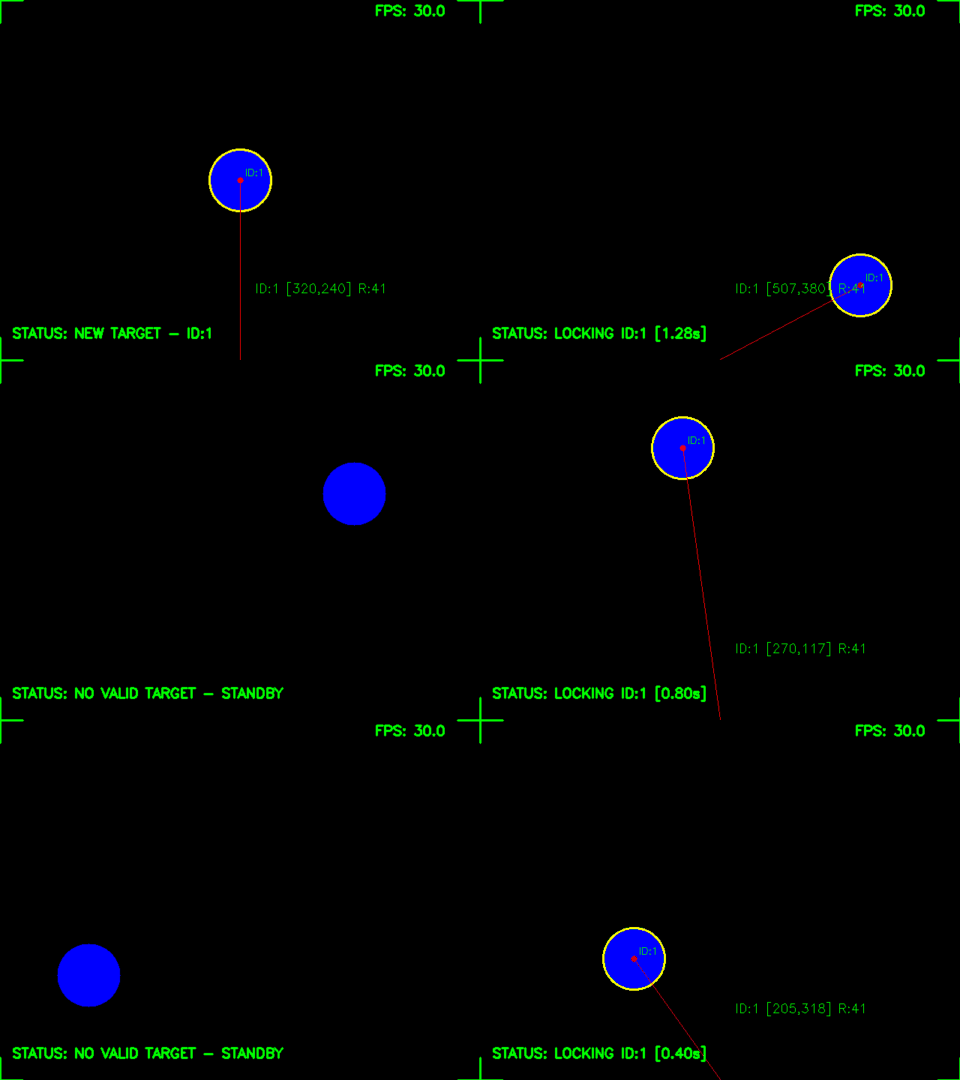 |
| AURORA · sound driving a shader | LETHEFS · files decaying into quarantine | BOZGUN · detect → track → lock on |


GROUNDED_ANSWERS // CITATION_TRACKING // SEMANTIC_CHUNKING // OFFLINE_FALLBACK // REFUSAL_LAYERS


R_PEAK_DETECTION // COLOUR_TRACKING // DEAD_RECKONING // FFT // ADAPTIVE_THRESHOLDING




Portfolios only show finished things, which makes everything look equally easy. These are real defects I found in my own work, and the change each one forced.
! ANAMNESIS · the offline vectoriser collided
- a question about currency hedging retrieved a triage document, score 0.11
+ lexical gate added: a passage must share a real term before it counts as evidence
+ two tests — one asserts off-topic queries return nothing, one asserts that
+ WITHOUT the gate they would not, so the guard cannot be removed silently

! CARDIA · the dashboard showed a blood-pressure figure
- an AD8232 cannot measure blood pressure
+ removed; modelled values are now labelled as modelled

! UNICORN · position reported as a bare coordinate
- no wheel encoders, so dead reckoning drifts and a coordinate hides that
+ position is a disc with an uncertainty radius, different constants when uncalibrated
- two motor pins sat on ESP32 strapping pins; a blocking pulseIn stalled the loop
+ repinned and replaced — both caught by moving mission logic off the board

! HELIXIR · the README framed the DNA layer as encryption
- encoding is not encryption
+ reframed: AES-256-GCM does the work, A/C/G/T is representation

! ORCHIDIA · the UI said "live conditions" over simulated readings
+ says simulated now, in the interface and in the docs
The pattern is the same every time. The bug was never the algorithm — it was a claim the system was not entitled to make.
# 1 · a grounded answer, and the evidence behind it
git clone https://github.com/nisamaasoglu/anamnesis && cd anamnesis
pip install -r requirements.txt && python run.py
#   ask  "What are the visiting hours in the intensive care unit?"
#   →    the answer names the document and section it used
#   ask  "Do I have cancer?"
#   →    refused before any tool runs, with the route to a human

# 2 · the tests that hold it together
pip install -r requirements-dev.txt && python -m pytest -q      # 45 passed

# 3 · firmware logic, verified with no hardware attached
git clone https://github.com/nisamaasoglu/Unicorn && cd Unicorn
./tools/run_tests.sh
Anamnesis 45 · Helixir 25 · Aurora 16 · Orchidia 13 — plus Unicorn's host-compiled C++ suite. CI runs ruff and pytest on Python 3.10 / 3.11 / 3.12 on every push.
[01]  TEST THE DECISION, NOT THE DEVICE
      The logic that decides — is this a heartbeat, is this a survivor, has this
      file been forgotten, is this passage evidence — is separated from the
      hardware or model feeding it. Testable on a laptop with nothing attached.

[02]  STATE THE UNCERTAINTY
      An estimate that reports its own error is worth more than a confident
      number that quietly lies.

[03]  DECLARE THE MODE
      Anamnesis reports generative:false when no model is running. Cardia prints
      "--" with no electrode. Orchidia labels simulated readings as simulated.
      A system that hides which mode it is in is lying politely.

[04]  DOCUMENT WHAT EXISTS
      No roadmaps. No planned features. No claim I could not defend in a
      technical interview.

