

Visual portfolio | Two-page portfolio brief | Evidence repository | LinkedIn
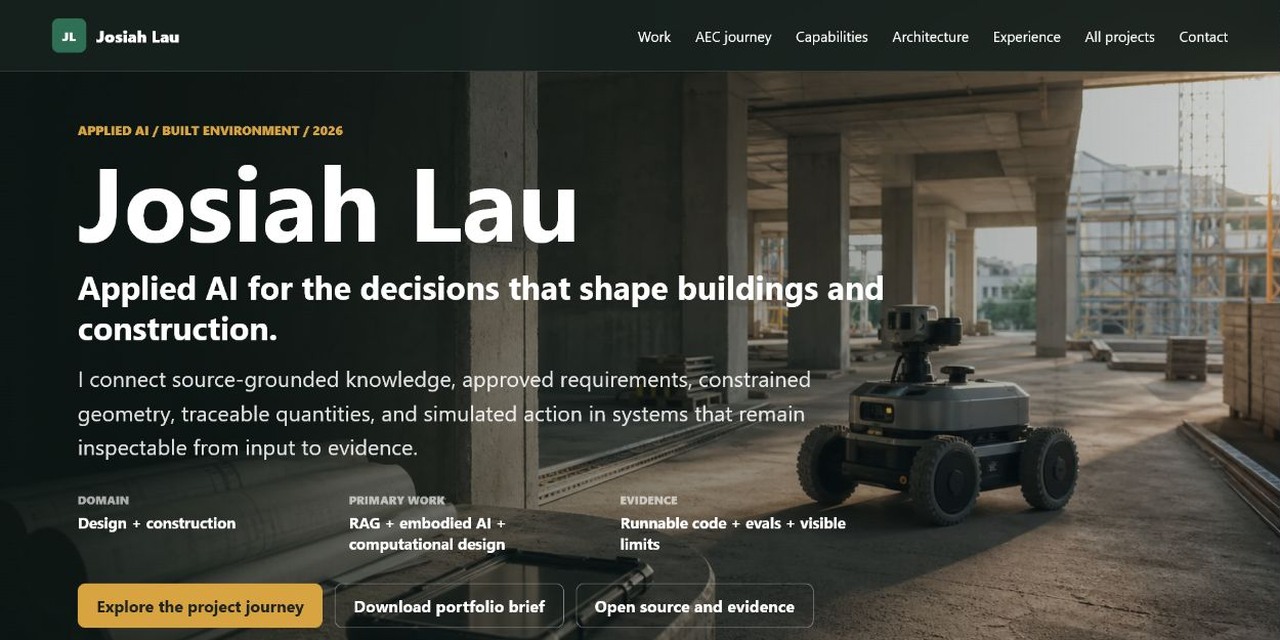
Homepage preview. The construction-robot backdrop is a generated concept image; measured project evidence and explicit boundaries begin below.
I build evaluated AI systems for design and construction decisions. My architecture background gives me a domain lens for public AEC documents, spatial constraints, project requirements, quantity takeoff, and construction robotics; tests, evaluation fixtures, and reproducible outputs carry the technical claims.
| Project | Engineering evidence | Boundary |
|---|---|---|
| AEC Code Compliance RAG | Validated Singapore public-source downloads, four local retrieval modes, citations, abstention, an authenticated service contract, bounded durable telemetry, fixed query objectives, evals, and tests. | Document assistance and in-process reliability evidence, not compliance certification, deployment, uptime, or capacity. |
| Construction Embodied Agent Simulator | Procedural train/holdout grids, expert trajectories, behavior cloning, closed-loop metrics, action filtering, and visible failures. | Structured 2D simulation, not a foundation VLA or robot deployment. |
| Constraint-Aware Massing Explorer | Seeded geometry, hard constraints, Pareto ranking, baseline comparison, transparent proxy metrics, tests, and generated diagrams. | Rectangular proxy model, not code compliance or professional design. |
- Executed design-to-cost integration contract: approved-requirement gating, field-level sources, deterministic massing selection, schematic takeoff, rejection tests, and explicit human review boundaries.
- Project Communication and Specification Assistant: role-tagged communication, requirement versions, conflict detection, approval scopes, audit events, source-linked draft clauses, and a direct/paraphrase/negative language stress audit with retained failures.
- QS Takeoff and Tender Analysis Workbench: shared-wall measurement, opening deductions, rate provenance, uncertainty bands, and transparent tender exceptions.
- Source-grounded AI: ingestion, retrieval baselines, citations, abstention, structured outputs, and eval harnesses.
- Embodied AI: language-to-task parsing, state transitions, action masks, route planning, policy comparison, and replayable simulation traces.
- Computational design: parametric geometry, constraint validation, Pareto ranking, and visual evidence.
- AEC workflow automation: requirements, approvals, quantity provenance, cost build-up, and human review boundaries.
- Engineering practice: Python, Pydantic, pandas, NumPy, scikit-learn, Streamlit, FastAPI, SQLite, pytest, Ruff, Black, Docker, and GitHub Actions definitions.
Projects are local prototypes unless explicitly stated otherwise. Synthetic data, public-source subsets, mock LLM/VLM providers, and simulation-only robotics are labeled at project level. The repository does not claim customer adoption, production ownership, professional compliance validation, professional QS output, or robot-hardware deployment.