


The Musical Gestures Toolbox for Python is a collection of tools for visualizing and analysing audio and video files.
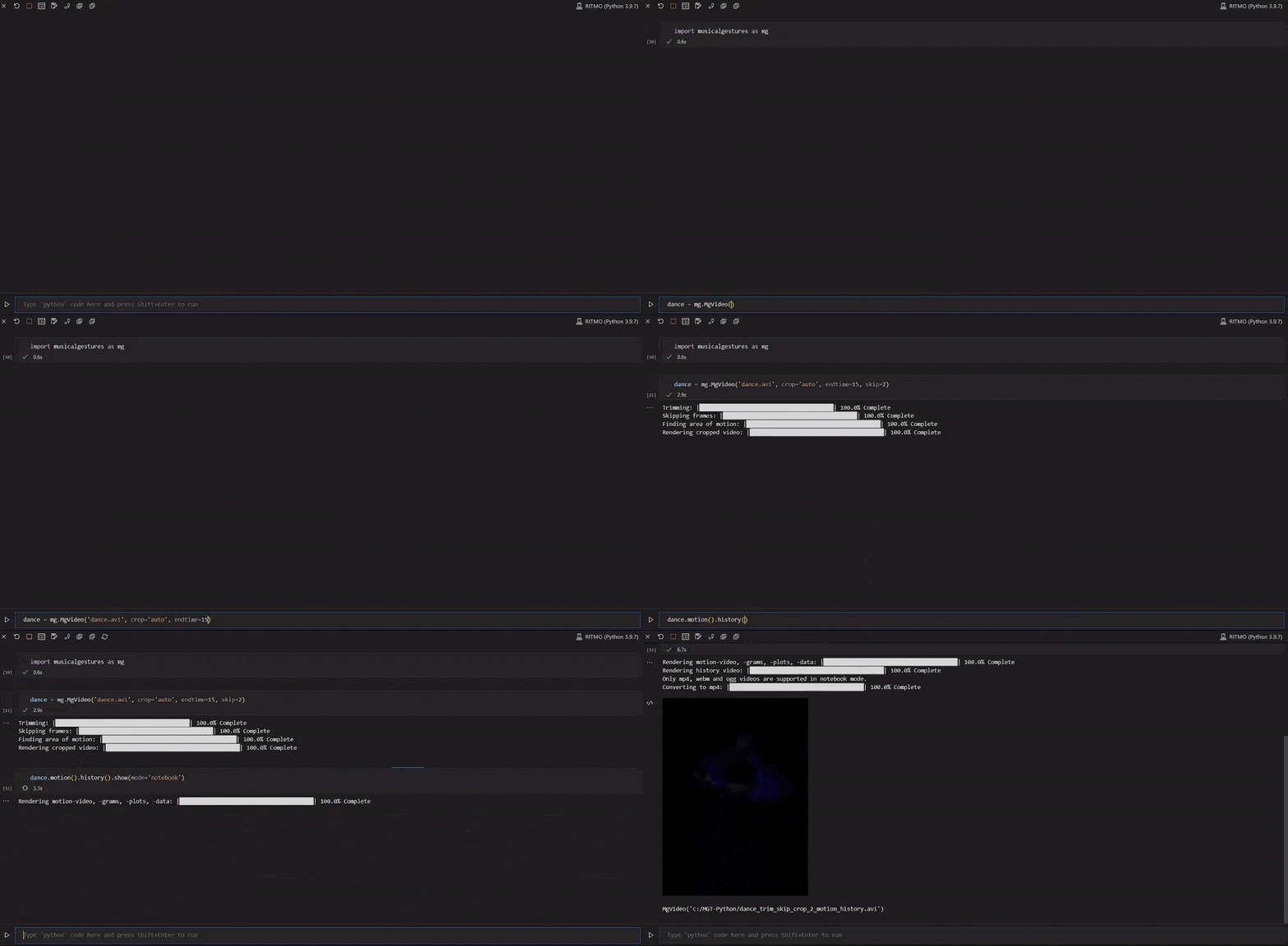
pip install musicalgesturesmusicalgestures installs its core Python dependencies automatically. You still need a working ffmpeg installation on your system for video processing. For the pose-landmark-trajectory tools (extract_pose_landmarks, see below), add the optional [pose] extra: pip install musicalgestures[pose] (installs MediaPipe).
import musicalgestures as mg

# Load a video (mp4, avi, mov, … all supported)
v = mg.MgVideo('dance.mp4')

# Create visualizations — call .show() to display the result
v.grid().show()
v.videograms().show()
v.average().show()
v.history().show()
v.heatmap().show()              # where the video changes most

# Motion analysis
v.motion().show()
v.motiontempo().show()          # dominant movement tempo (Hz/BPM)
v.motiondescriptors().show()    # motion energy, smoothness, entropy, spectral descriptors
v.eulerian(mode='motion').show()  # amplify subtle motion (EVM)

# Audio analysis
v.audio.waveform().show()
v.audio.spectrogram().show()
v.audio.mfcc().show()
v.audio.tempo().show()          # tempo + beat tracking
v.sonomotiongram().show()       # sonify the motiongram

# Pose estimation (MediaPipe is GPU-capable on the standard pip OpenCV)
v.pose(model='mediapipe').show()
Display happens via
.show()— analysis methods return result objects (MgVideo/MgImage/MgFigure) and do not auto-render.
import musicalgesturesis fast: heavy dependencies are lazy-loaded, so the relevant backends load on first use rather than at import time.ffmpegis required for video I/O and preprocessing.pose()defaults to the MediaPipe backend and downloads its weights on first use if they are missing; the OpenPose models ('body_25'/'coco'/'mpi') download their larger Caffe weights on first use instead.- In notebooks and other non-interactive runs, missing pose weights are downloaded automatically when possible.
- If
device='gpu'is requested but OpenCV CUDA support is unavailable,pose()falls back to CPU execution. flow.dense(),flow.sparse(), andblur_faces()use CPU by default (use_gpu=False). Setuse_gpu=Trueto opt into CUDA acceleration with automatic CPU fallback.get_cuda_device_count()is available to quickly check whether OpenCV sees CUDA devices.blur_faces()returns the generated result object consistently, including whensave_data=True.

- Installation Guide
- Quick Start Tutorial
- API Reference
- Sound–Movement Analysis Toolkit
- Wiki & How-Tos
- Contributing
- Video Analysis: Motion detection, optical flow, motion vectors, movement tempo, Eulerian Video Magnification, frame-rate/speed resampling (
resample()), motion descriptors (energy/smoothness/entropy/spectral viamotiondescriptors()) - Pose Estimation: MediaPipe (default; fast on plain CPU, GPU-capable) and OpenPose (multi-person) backends, with average-pose and trajectory summaries (per-marker quantity of motion + dominant frequency), optional marker motion trails, a 3D pose waterfall (
pose_waterfall()), per-segment circular statistics (pose_segments()), centroid centring (pose_center()), and per-marker distance travelled (pose_distance()) - Audio–movement analysis: Compare a single performer's sound and motion — tempo similarity, phase synchrony, structural similarity, per-body-part audio coupling, and loudness/dynamics coupling
- Sound–movement research toolkit: Lower-level, array-based functions from the author's ro/stillstanding/Westney/cymbal studies — pulse/cycle segmentation, cross-modal alignment, body-scale-normalized quantity of motion, postural sway metrics, physiology features, mocap I/O, and pose-landmark trajectory extraction (see Sound–Movement Analysis Toolkit below)
- Audio Processing: Waveforms, spectrograms, MFCC, chromagrams, tempo/beat tracking, spectral descriptors
- Visualizations: Motiongrams, videograms, motion history, heatmaps, sonomotiongrams (motion → sound)
- Space-time displays: Stroboscope (chronophotography), silhouette waterfall, Motion History Image, 3D space-time volume, combined motion SSM
- Integration: Works with NumPy, SciPy, librosa, and Matplotlib ecosystems
- Cross-platform: Linux, macOS, Windows support
Alongside the MgVideo/MgAudio methods above, MGT-python exposes a lower-level toolkit of
plain-numpy sound–movement analysis functions, ported from the author's own research pipelines
(the ro ritual-drumming study, the stillstanding/standstill-championship posturography
study, the Westney with/without-audience piano comparisons, and the cymbal-comparison
striking study). They work on arrays — not on MgVideo/MgAudio objects — so they drop straight
into notebooks, batch scripts, or your own analysis pipeline, and are all importable directly from
musicalgestures:
_peaks—pick_peaks: the one adaptive peak-picker (smoothing, relative threshold, minimum interval, prominence gate) shared by every event detector below._pulse—Cycle,group_strokes,segment_cycles,cycle_table,fit_accelerando,motion_onsets: group onsets into rhythmic cycles and fit an exponential accelerando._alignment—xcorr_lag,envelope_lag,per_cycle_motion_delta,anchor_and_match,offset_stats,sliding_correlation,envelope_agreement: lead/lag and coupling between two (or more) time-aligned signals._qom—band_limited_qom,accel_to_speed,group_qom,pose_qom,body_scale,normalized_qom,grid_qom,envelope,bin_series: quantity-of-motion cores for position, pose-landmark and accelerometer data, including body-scale (framing-invariant) normalization._audiofeatures—rms_envelope,spectral_flux,spectral_flux_onsets,energy_onsets,t60_backward_decay,attack_spectral_centroid: scipy-only audio features and onset detectors._posture—cop_sway_metrics,confidence_ellipse_area,convex_hull_area,stabilogram_diffusion,dfa,sample_entropy,spectral_edges,sway_texture,sway_orientation,axial_rayleigh,spatial_extent,principal_axis_projection: standing-sway and postural-control metrics from a centre-of-pressure or marker trace._physio—respiration_rate,spectral_band_fractions: breathing rate and spectral composition of physiological waveforms._mocap—read_qtm_tsv,compare_modality_envelopes: a robust Qualisys (QTM) TSV reader and cross-modality envelope comparison. (_mocapalso defines its owndominant_frequency, a Welch-peak variant kept asmusicalgestures._mocap.dominant_frequencyrather than re-exported at top level, since it would otherwise shadow the pre-existingmusicalgestures.dominant_frequency.)_posetools—extract_pose_landmarks,midpoint,limb_speed_from_landmarks,impact_events: video → tidy per-landmark trajectory arrays, plus derived limb-speed and impact-event signals.extract_pose_landmarksneeds MediaPipe (pip install musicalgestures[pose]), imported lazily — the derived-signal helpers are numpy-only.motiongram_data(in_motionanalysis) gained anorientation='vertical'|'horizontal'option for the numpy-level motiongram, matching the twomotiongrams()render directions.
A few illustrative snippets:
# Pulse-train segmentation: group stroke onsets into rhythmic cycles and fit
# an accelerando (ro study)
import numpy as np
from musicalgestures import segment_cycles, cycle_table, fit_accelerando

onsets = np.array([0.10, 0.34, 1.02, 1.24, 1.85, 2.02, 2.55, 2.68])  # seconds
cycles = segment_cycles(onsets)                  # -> list[Cycle]
table = cycle_table(cycles, clip_id='ro_2023')    # per-cycle DataFrame
ioi0, t_double, r2 = fit_accelerando(table['t'], table['ioi'])
print(f"tempo doubles every {t_double:.1f}s (R²={r2:.2f})")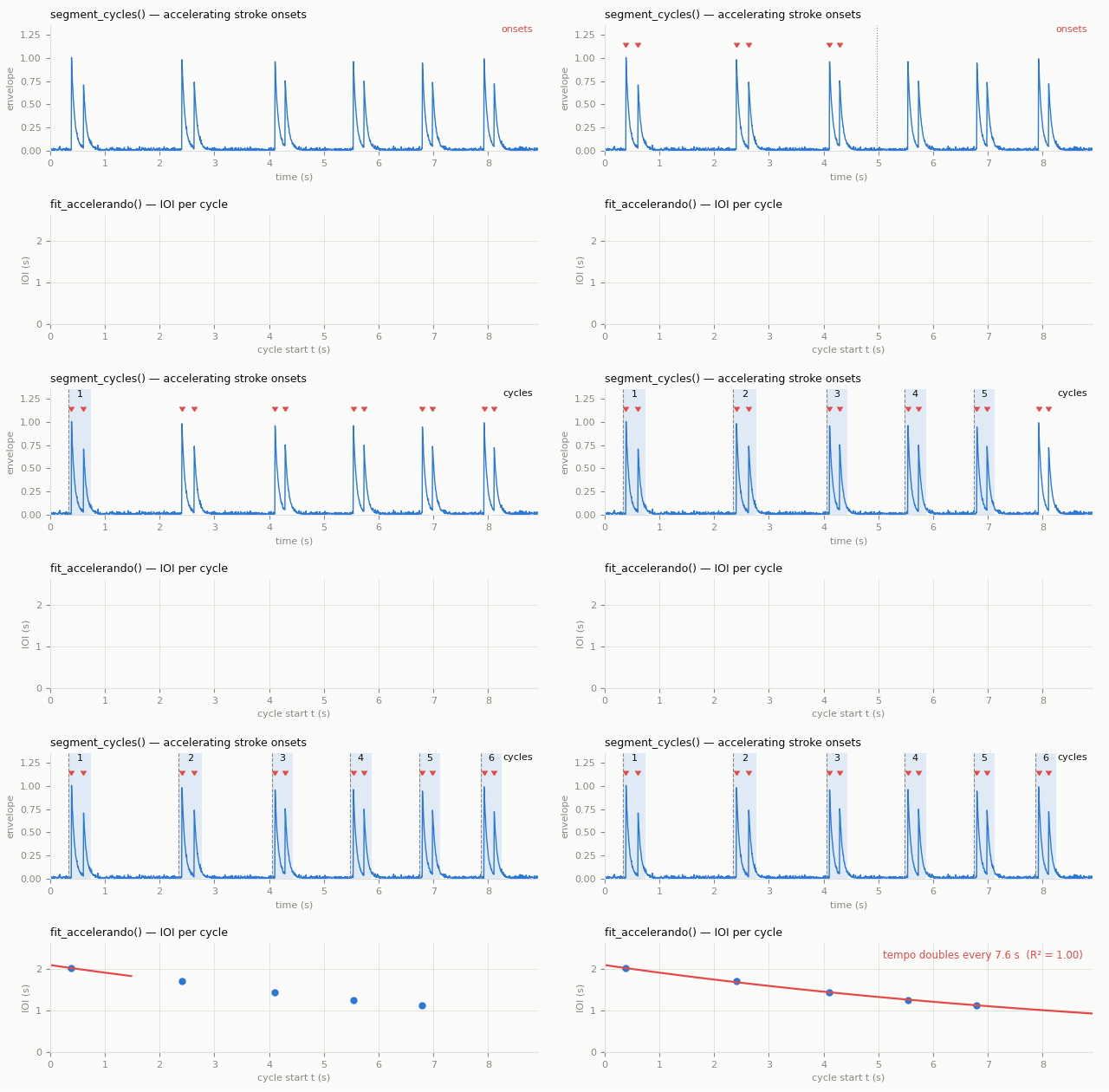
# Quantity of motion + body-scale normalization: framing-invariant QoM in
# body-lengths/second, comparable across recordings/zoom levels (Westney study)
from musicalgestures import extract_pose_landmarks, normalized_qom

traj = extract_pose_landmarks('performance.mp4', fps=25, width=480)
qom, speed, fs_out = normalized_qom(traj['landmarks'][..., :2], traj['fps'])
print(f"{qom:.3f} body-lengths/s")
# Standing-sway metrics from a centre-of-pressure (or marker) trace (stillstanding study)
from musicalgestures import cop_sway_metrics
metrics = cop_sway_metrics(cop_xy, fs=100.0) # cop_xy: (T, 2) array [ML, AP], mm
print(metrics['path_len'], metrics['area95'], metrics['ap_ml_sd_ratio'])# Pose-trajectory extraction and impact detection from striking gestures (cymbal study)
from musicalgestures import extract_pose_landmarks, limb_speed_from_landmarks, impact_events
traj = extract_pose_landmarks('strike.mp4', fps=30, width=640)
wrists = traj['landmarks'][:, [15, 16], :2] # left/right wrist, px
conf = traj['landmarks'][:, [15, 16], 2]
speed = limb_speed_from_landmarks(wrists, conf, traj['fps']) # px/s, bilateral max
impacts = impact_events(wrists, traj['fps']) # acceleration-peak eventsSee the API reference for full signatures and each function's provenance note.
See this short video presentation made for the Nordic Sound and Music Computing Conference 2021:

- Python 3.10+
- FFmpeg
- See installation guide for complete requirements
This toolbox builds on the Musical Gestures Toolbox for Matlab, which again builds on the Musical Gestures Toolbox for Max. Many researchers and research assistants have helped its development over the years, including Balint Laczko, Joachim Poutaraud, Frida Furmyr, Marcus Widmer, Alexander Refsum Jensenius
The software is currently maintained by the fourMs lab at RITMO Centre for Interdisciplinary Studies in Rhythm, Time and Motion at the University of Oslo.
If you use this toolbox in your research, please cite this article:
- Laczkó, B., & Jensenius, A. R. (2021). Reflections on the Development of the Musical Gestures Toolbox for Python. Proceedings of the Nordic Sound and Music Computing Conference, Copenhagen.
@inproceedings{laczkoReflectionsDevelopmentMusical2021,
    title = {Reflections on the Development of the Musical Gestures Toolbox for Python},
    author = {Laczkó, Bálint and Jensenius, Alexander Refsum},
    booktitle = {Proceedings of the Nordic Sound and Music Computing Conference},
    year = {2021},
    address = {Copenhagen},
    url = {http://urn.nb.no/URN:NBN:no-91935}
}This toolbox is released under the GNU General Public License 3.0 license.