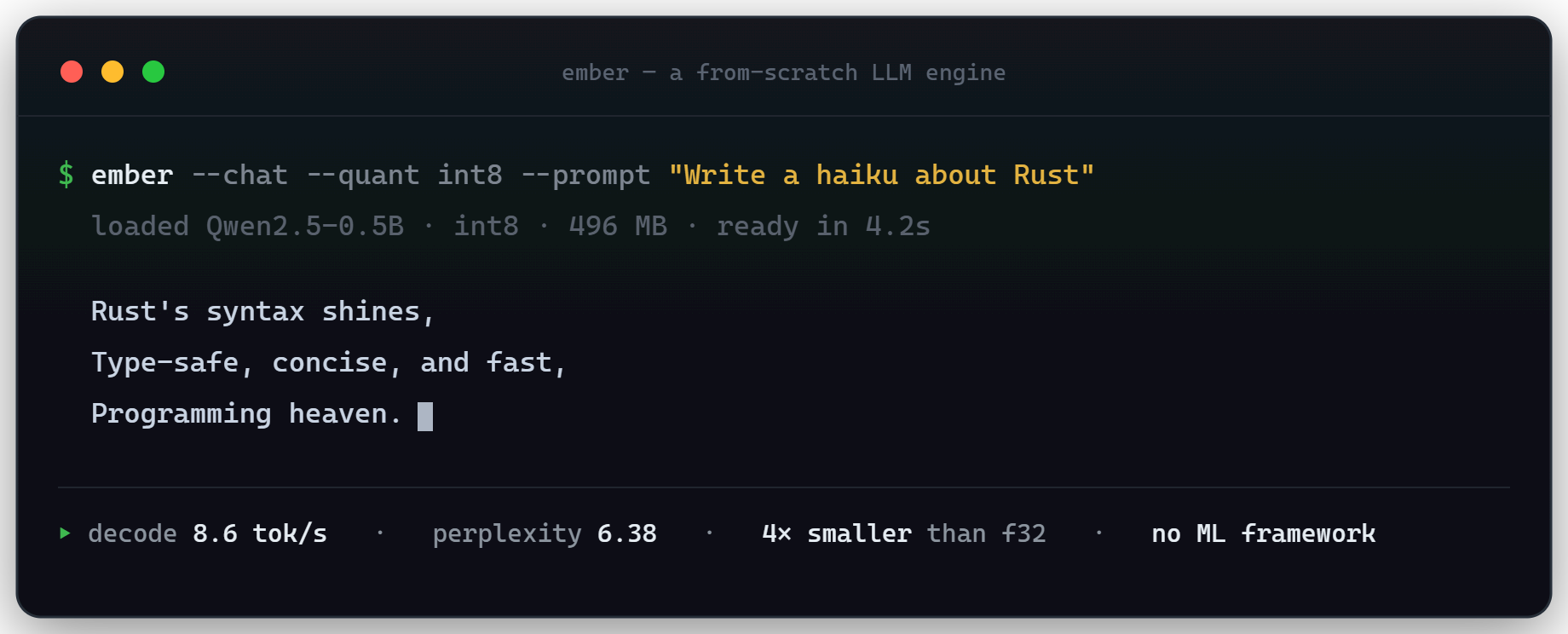
A from-scratch LLM inference engine in Rust.
Run a real language model on your CPU — no framework, no GPU, no server.
Hand-written transformer · RMSNorm · RoPE · GQA + KV-cache · SwiGLU
•
INT8 / INT4 quantization
•
no TensorFlow / PyTorch / candle


What it is · Metrics · How it works · Quickstart · Verified
Most "LLM in Rust" projects are a wrapper around candle or llama.cpp.
ember isn't. The transformer forward pass — attention, the KV cache, RoPE, quantization —
is written by hand. The only dependencies are plumbing: weight loading, the tokenizer, threads.
~1,300 lines of Rust. No ML framework. No GPU. Runs a real Qwen2.5 model on a laptop CPU.
|
Every kernel from scratch — |
Custom INT8 and group-wise INT4 with a fused dequant mat-vec — 4× / 7× smaller, and INT8 is quality-lossless (measured, not claimed). |
Green CI (build + 13 tests + a live run), a NumPy oracle that mirrors the math, and perplexity numbers — this is evaluated, not just "it runs". |
Real numbers, Qwen2.5-0.5B, through the compiled engine — not estimates.
Quality & memory — perplexity over a fixed passage (--perplexity, lower is better):
| scheme | weights | vs f32 | perplexity ↓ | verdict |
|---|---|---|---|---|
f32 |
1976 MB | 1.0× | 6.49 | baseline |
int8 |
496 MB | 4.0× | 6.38 | quality-lossless — within noise of f32 |
int4 (group-64) |
278 MB | 7.1× | 7.75 | +19% — a real, quantified trade |
Latency — greedy, single CPU (--prompt … -n 20):
| scheme | prefill | decode |
|---|---|---|
f32 |
8.3 tok/s | 8.6 tok/s · 116 ms/tok |
int8 |
6.6 tok/s | 6.6 tok/s · 152 ms/tok |
The headline: INT8 gives 4× less memory for free (perplexity 6.38 vs 6.49). INT4 buys 7× less memory for ~19% perplexity. Quantization is a memory win here; the scalar dequant trades a little throughput, so SIMD dequant is the natural next step.
One decode step is a stack of hand-written kernels. The ego of the whole project is that every box below is code in this repo, not a library call.
%%{init: {'theme':'base','themeVariables':{'primaryColor':'#161b22','primaryTextColor':'#e6edf3','primaryBorderColor':'#f0883e','lineColor':'#f0883e','fontSize':'14px'}}}%%
flowchart LR
  TOK["token id"] --> EMB["Embedding<br/>(dequantized row)"]
  EMB --> BLK
  subgraph BLK["× 24 transformer blocks"]
    direction TB
    N1["RMSNorm"] --> ATT["Grouped-Query Attention<br/>RoPE · causal KV cache"]
    ATT --> R1(("+"))
    R1 --> N2["RMSNorm"]
    N2 --> MLP["SwiGLU MLP"]
    MLP --> R2(("+"))
  end
  BLK --> FN["RMSNorm"]
  FN --> LM["LM head<br/>(tied embedding)"]
  LM --> LOG["logits"] --> SMP["sample"] --> TOK

  classDef s fill:#161b22,stroke:#30363d,color:#e6edf3;
  class TOK,EMB,N1,ATT,R1,N2,MLP,R2,FN,LM,LOG,SMP s;
Module map
| Module | Responsibility |
|---|---|
config.rs |
Parse the Qwen2.5 config.json (GQA-aware) |
tensor.rs |
The rayon-parallel mat-vec hot loop |
ops.rs |
RMSNorm · RoPE (rotate-half) · SwiGLU · softmax |
attention.rs |
Grouped-query attention + rolling KV cache |
quant.rs |
INT8 / group-wise INT4 quantization + fused dequant mat-vec |
sample.rs |
Greedy / temperature / top-p sampling |
model.rs |
safetensors loading (bf16→f32) + the forward pass |
chat.rs |
Qwen ChatML formatting |
main.rs |
CLI, generation loop, --bench, --perplexity |
# 1. Rust toolchain (https://rustup.rs)
rustup default stable

# 2. Fetch a small model  (needs: pip install huggingface_hub)
huggingface-cli download Qwen/Qwen2.5-0.5B-Instruct \
  model.safetensors config.json tokenizer.json --local-dir ./weights

# 3. Chat, or complete, or quantize
cargo run --release -- --chat --prompt "Write a haiku about Rust programming."
cargo run --release -- --prompt "The capital of France is" --quant int8
cargo run --release -- --perplexity --quant int4     # measure quality
cargo run --release -- --bench --quant int8          # measure throughput
On Windows, the tokenizer needs a C compiler at build time — use WSL, or install WinLibs / MSVC Build Tools. Linux & macOS work out of the box.
Nothing here is "trust me":
- CI — every push runs
cargo build --release, 13 unit tests, and a live--benchon the runner (status). - NumPy oracle —
scripts/reference_forward.pyreimplements the exact math; the Rust output matches it token-for-token. - Perplexity — the quantization quality numbers above are measured, not asserted.
$ ember --chat --prompt "What is the capital of France? Answer in one sentence."
The capital of France is Paris.See PHASES.md.
- Phase 1 — Correctness — hand-written forward pass; generates coherent text
- Phase 2 — Performance — INT8 / INT4 quantization (4× / 7× memory) +
--bench - Phase 3 — Polish — chat mode, unit tests, perplexity + latency metrics, CI
- Next — SIMD dequant (throughput), a static-linked binary, a perf PR upstream
Built by Ali Zulfiqar — a transformer, from the gradients up.