




A conformance + safety linter for MCP servers. Point it at any Model Context Protocol server — stdio or Streamable HTTP — and get a report.
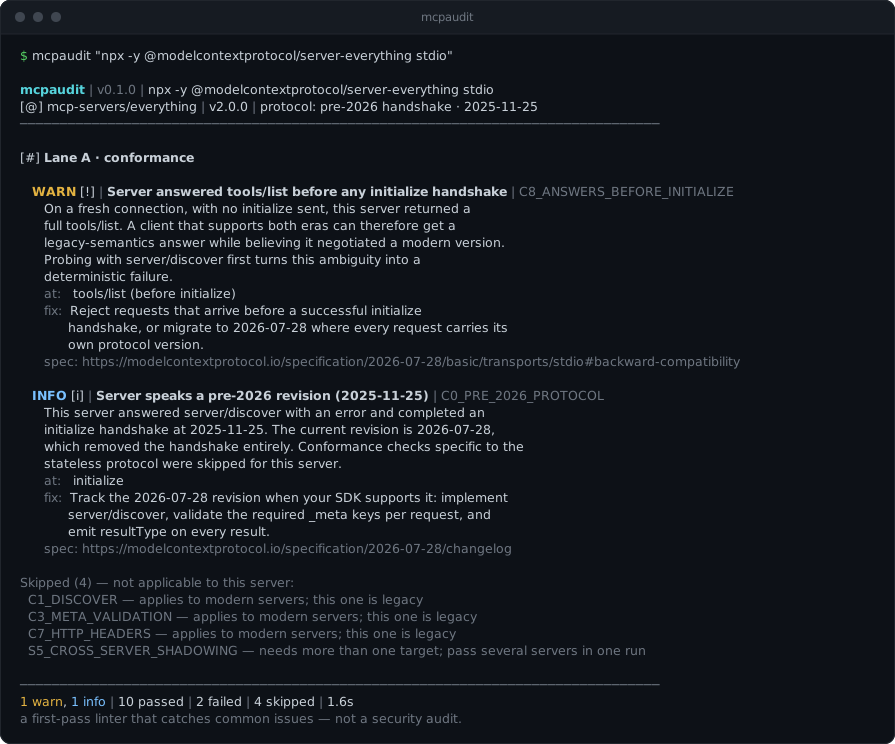
npx @aethereumdev/mcp-audit "npx -y @modelcontextprotocol/server-filesystem /tmp"Zero runtime dependencies. No API key. No telemetry. The only network traffic is to the server you asked it to audit.
Case study: brunojaamaa.dev/projects/mcpaudit
Real audits of four official reference servers, run with this tool at v0.1.0. Raw
--json output for every row is committed under audits/ — nothing here is
summarised by hand. The Reports itself as column is the server's own serverInfo,
which is what the audit records; it does not always match the npm package name.
| Server (npm) | Reports itself as | Protocol | Findings |
|---|---|---|---|
@modelcontextprotocol/server-everything |
mcp-servers/everything 2.0.0 |
2025-11-25 | 1 warn, 1 info |
@modelcontextprotocol/server-filesystem |
secure-filesystem-server 0.2.0 |
2025-11-25 | 1 warn, 1 info |
@modelcontextprotocol/server-memory |
memory-server 0.6.3 |
2025-11-25 | 1 warn, 1 info |
@modelcontextprotocol/server-sequential-thinking |
sequential-thinking-server 0.2.0 |
2025-11-25 | 1 warn, 1 low, 1 info |
The headline is the Protocol column. The current specification revision is
2026-07-28, which removed the initialize handshake and made server/discover
mandatory. Every server above — and every SDK we could find — still speaks an
initialize-era revision. That is not a defect in these servers; it is where the
ecosystem is. It is also why every check in this tool is era-aware: checks written for
the stateless protocol are skipped with a stated reason against older servers rather
than failed. Without that, this table would be a wall of false failures.
The recurring warn is finding C8_ANSWERS_BEFORE_INITIALIZE, from rule
C8_LEGACY_PREINIT: all four answer tools/list on a fresh connection with
no handshake sent. The specification calls this out directly as a version-negotiation
hazard, and it is why it recommends probing with server/discover first even for clients
that only speak modern revisions.
No exploitable vulnerability was found in any audited server, and nothing here was disclosed privately first because there was nothing to disclose. These are hygiene and spec-currency observations about servers that are, by design, demonstration and reference implementations.
A first-pass linter that catches common issues — not a security audit.
That framing is load-bearing. This tool reads what a server says about itself — tool names, descriptions, schemas, annotations, protocol behaviour — and applies documented heuristics. It does not execute tools in a sandbox, analyse server source, or prove anything. A clean report means "nothing common was found", not "this server is safe".
Every check documents how it misfires, in RULES.md, which is generated
from the rule metadata in code so the docs cannot drift. falsePositiveModes is a
required field on every rule, and CI fails if the committed RULES.md is stale.
This discipline is not decorative. Auditing the official filesystem server surfaced four
findings that turned out to be false positives — the word "clearly" in a description was
matching the destructive verb clear. That bug was found by hand-reviewing every finding
before publishing this table, and there are now regression tests for those exact strings.
If a check fires on your legitimate server, that is a bug in the check; please report it.
Lane A — conformance. Does it implement the specification correctly? Built against
2026-07-28 (stateless) first, with a back-compat lane for initialize-era servers.
Nine checks, C0–C8.
Lane B — safety. Is it dangerous? Tool poisoning, annotation contradictions,
credential exposure, $ref SSRF, cross-server shadowing, terminal-escape injection,
unsafe icon URIs. Seven checks, S1–S7. These are heuristics — they surface signals
a human should look at; they do not prove anything.
Plus drift. D1_SURFACE_DRIFT diffs a server against a baseline you pinned earlier.
It lives outside the rule registry because it needs a caller-supplied baseline, which is
why src/rules/ holds seven files while the documentation lists eight safety checks.
17 checks in total. All of them are in RULES.md, with their false-positive modes.
flowchart TD
    T["target: a command, or a URL"] --> D{detectTargetKind}
    D -->|command| S["stdio transport<br/>shell:false, hand-tokenized"]
    D -->|URL| H["Streamable HTTP transport"]
    S --> C["McpClient — never throws;<br/>caps on line size, body size, stderr"]
    H --> C
    C --> E{detectEra}
    E -->|"server/discover answers"| M["modern · 2026-07-28"]
    E -->|"-32601, then initialize"| L["legacy · pre-2026"]
    M --> R["rule registry"]
    L --> R
    R --> LA["Lane A · conformance<br/>C0–C8"]
    R --> LB["Lane B · safety<br/>S1–S7"]
    B[("pinned baseline")] --> DR["D1 · surface drift"]
    LA --> AR["AuditReport"]
    LB --> AR
    DR --> AR
    AR --> O1["terminal"]
    AR --> O2["--json"]
    AR --> O3["--sarif"]
Two decisions shape everything above.
Era is resolved before any check runs. Every rule declares which eras it applies to,
and an inapplicable check is skipped with a reason, never failed. This was not the
original design; it became mandatory once research showed that no shipping server
implements 2026-07-28. Firing modern checks at legacy servers would produce a wall of
false positives and destroy the tool's credibility on contact.
The transport never throws. A hostile server is data, not an exception — every
request returns an outcome (result, error, timeout, transport-error,
invalid-json, invalid-envelope), so a server that emits garbage, hangs, or dies
mid-conversation produces a finding rather than a stack trace.
The full record is in masterplan.md — sprint by sprint, with as-shipped deltas, deferrals and their reasons. Four repairs are worth pulling out, because each one is a bug a green test suite was actively hiding.
The CLI worked in tests and produced no output when packed. The
import.meta.url === file://${process.argv[1]} entry-point guard silently fails under
npx, because npm installs bin as a symlink. Every unit test passed throughout. Only an
acceptance test that ran the packed binary caught it, so packing-and-running is now a CI
step rather than a pre-release ritual.
A determinism check never fired because the fixture was a palindrome. The
deliberately-broken fixture reversed its tool order to trip C2_NONDETERMINISTIC_ORDER,
but its tool names were symmetrical, so reversal was a no-op. A fourth tool broke the
symmetry. Similarly, S6_CONTROL_IN_OUTPUT scanned the raw wire bytes, where an ESC byte
always arrives already JSON-escaped, so it could never match. It now scans decoded text.
Two false positives on the benign fixture were both modes I had documented but not
implemented. S1_HIDDEN_CHARACTERS fired on the zero-width joiners inside an emoji
sequence; S2_DESTRUCTIVE_CLAIMS_READONLY fired on remove_background. The fix was a
two-tier verb model: strong verbs (delete, drop, purge, wipe) count alone, weak
verbs (remove, reset, clear) count only when paired with a stateful object and only
in the tool name — prose is too noisy to carry that signal.
The rug-pull detector hashed uncanonicalised JSON, so a server that merely reordered its keys would have looked like a deliberate downgrade on every re-audit. Keys are sorted before hashing now, and that is tested explicitly.
Two more, briefly: the report sanitises every finding before display, because otherwise a server flagged for ANSI injection could inject ANSI into the report flagging it. And the first version of the weekly spec-drift job was circular — it read the protocol version out of the versioned file, which always matches itself; it now compares against the published revision directory listing.
| Tests | 114, across 13 files |
| CI | Node 20, 22, 24 — lint, typecheck, test, RULES.md staleness, packed-CLI smoke test |
| Fixtures | 8 stdio servers: benign, hostile, legacy, malicious, modern-bad, modern-good, reserved-code, shadow |
| Network required | none — every fixture runs locally |
The hostile fixture is the interesting one. It serves a 2000-tool list, a 400-deep schema, a 500-notification flood, garbage on stdout, truncated JSON, wrong-shaped envelopes, a frame with no trailing newline, a server that says nothing at all, and a server that exits mid-conversation. Those tests passed on the first run, which is the payoff for the size caps and never-throw transport rather than a coincidence.
The image at the top of this page is generated, not drawn:
scripts/make-demo-svg.mjs runs the built CLI against a
real server, parses the ANSI it emits, and writes the SVG. Regenerate it with
npm run build && node scripts/make-demo-svg.mjs. The elapsed time in the summary line is
a real measurement, so it moves between runs.
Reproduce the two ends of the range yourself, with no network:
npm run build
node dist/cli.js "node fixtures/malicious/server.mjs"   # 12 error, 10 warn — exit 1
node dist/cli.js "node fixtures/benign/server.mjs" # clean — exit 0# stdio (a command)
npx @aethereumdev/mcp-audit "npx -y @modelcontextprotocol/server-memory"
# Streamable HTTP (a URL)
npx @aethereumdev/mcp-audit https://example.com/mcp
# CI: SARIF for GitHub code scanning
npx @aethereumdev/mcp-audit https://example.com/mcp --sarif > mcp.sarif
# Cross-server shadowing needs more than one target
npx @aethereumdev/mcp-audit "npx -y server-a" "npx -y server-b"Anything after -- is passed through verbatim to a stdio server command.
A server can pass review and then quietly rewrite a tool description — which changes the instructions your model follows, with no version bump and no code change on your side. Pin the surface, then diff it:
npx @aethereumdev/mcp-audit "npx -y my-server" --pin          # writes .mcpaudit-baseline.json
npx @aethereumdev/mcp-audit "npx -y my-server" --baseline .mcpaudit-baseline.json
Drift reports which field changed, with the old and new values inline. Description and
schema changes are errors, because they alter what the model is told. Annotation changes
that weaken a safety claim (destructiveHint flipping to false) are called out
separately, because that is the shape of a deliberate downgrade rather than an ordinary
release edit. Drift means "changed since you approved it" — not "malicious".
| Flag | Meaning |
|---|---|
--json |
machine-readable report on stdout |
--sarif |
SARIF 2.1.0, for GitHub code scanning |
--fail-on <level> |
info | low | warn | error (default warn) |
--pin[=<path>] |
write a baseline snapshot (default .mcpaudit-baseline.json) |
--baseline <path> |
diff against a baseline; drift is a finding |
--timeout <ms> |
per-request timeout (default 10000) |
--color / --no-color |
force or disable ANSI colour; NO_COLOR is respected |
--icons <mode> |
auto | plain | nerd | none (default auto) |
-h, --help · -v, --version |
--pin takes its optional path with = only (--pin=path); a bare --pin path reads
path as another target. --json and --sarif are never styled.
Exit codes: 0 clean · 1 findings at or above --fail-on · 2 tool or connection
error, including a server we could not talk to at all. Designed for CI.
A security tool's own dependency tree is part of its argument.
| Runtime dependencies | 0 |
|---|---|
| Install lifecycle scripts | none — nothing runs on npm install |
| Network calls | only to the server you name |
| Node | ≥ 20 |
Both the zero-dependency claim and the absence of install scripts are enforced by a test, not just asserted here. Development uses TypeScript, vitest and eslint; none of it ships. What that costs is spelled out under Limitations.
A credibility section, not a weakness section. Everything here is a deliberate boundary.
- Schema validation is structural, not semantic.
inputSchemais checked for being parseable, an object,type: "object"at the root, and bounded in depth and$refcount — not validated against JSON Schema 2020-12, which would need a validator dependency. A schema can pass this check and still be rejected by a strict validator. - Only tools are inspected. Resource descriptions and prompt templates carry the same injection surface and are not covered yet.
- The modern lane is exercised against hand-written fixtures, because no shipping
server implements
2026-07-28.C7_HTTP_HEADERSin particular has never met a real modern HTTP server; none exists. - No token-passthrough or OAuth-metadata SSRF check. Deferred for the same reason:
there is no live
2026-07-28auth server to test against. S5_CROSS_SERVER_SHADOWINGneeds two or more targets in a single run, and is skipped otherwise.- No sandboxed execution, no source analysis, no spec-completeness claim. This covers common cases. It says so on purpose.
- Heuristics misfire. Every rule ships at least two documented false-positive modes. A false positive on your legitimate server is a bug in the check — please file it.
v0.1.0. All eleven engineering sprints are closed: both transports, 17 checks, era detection, terminal/JSON/SARIF output, pin-and-drift, 114 tests, CI on three Node versions, and a release pipeline on npm trusted publishing (OIDC) with automatic provenance. Release is tag-driven; no npm token exists in the repo or in CI.
One caveat worth stating rather than letting you discover it: 0.1.0 was published by
hand, so it carries no provenance attestation — npm view @aethereumdev/mcp-audit dist.attestations is empty. Only a CI publish can produce one, and none can be added
retroactively.
The release workflow carries no npm token by design and authenticates solely through trusted publishing, which is configured once on the registry side. Until that is done, releases are published manually and the workflow is inert rather than broken: it refuses a tag that disagrees with the manifest, skips a version that is already on the registry, and explains itself if authentication is not yet set up.
Next, in rough order of usefulness: resource and prompt coverage, an env-dump rule for
tools that return the whole environment, S8 token passthrough once there is anything to
test it against, and --theme loading for the TOML palettes the terminal report already
understands. See CONTRIBUTING.md for these as good first issues, and
the owner-gate block at the end of masterplan.md for what is left.
New rules and false-positive reports are equally welcome. A rule needs a stable id, a
why that can be checked against the specification, at least two honest false-positive
modes, a remediation, and both a fixture that triggers it and one that must not. See
RULES.md and the servers under fixtures/.
Security issues in this tool go to jaamaabruno@gmail.com. For issues found by this tool in someone else's server, see SECURITY.md.
MIT © Bruno Jaamaa · github.com/br9704