




Independent research lab building verification-first tooling for relational quantum models, scientific-literature inference, and applied environmental risk — with negative results published alongside positive ones.
Operator: Krzysztof W. Banasiewicz · Poland / EU · research indexed from 2025-04, public repositories since 2026-02 · contact@qhdalabs.com
QHDALabs is a one-person independent lab with 12 public repositories, growing out of
theoretical work on time and space as emergent from quantum information, indexed publicly from
April 2025 — a continuous line from that theory, through the algorithms it produced, into
applied systems (see Research lineage, whose chronology is provisional
pending a provenance reconstruction). The work spans three connected lines:
(1) relational quantum models — mid-circuit measurement used as a source of
conditional structure and emergent ordering (qmnet, qhda-core); (2) verification-first
scientific inference — a pipeline that tests candidate relations against explicit null models
before surfacing them (QHDALabs-Axon); (3) applied risk systems — an operational wildfire-risk
pipeline for Poland built on public satellite and geospatial data (QHDALabs-wildfire-risk-pl).
The distinguishing practice is methodological, not thematic: hypotheses are pre-registered with frozen statistics before results are seen, tested against explicit nulls with multiple-testing correction, and stopped when they fail. Three separate lines have produced published null or failed results — a pre-registered held-out test that did not recover, a confirmatory tier that failed its own contract and halted development, and a cosmological search that confirmed a null. Those failures are documented in-repo with the numbers, and are the strongest evidence here that the process is real.
No result in this lab has been peer-reviewed, run on physical quantum hardware, or externally validated. Everything below is labelled with what it actually is.
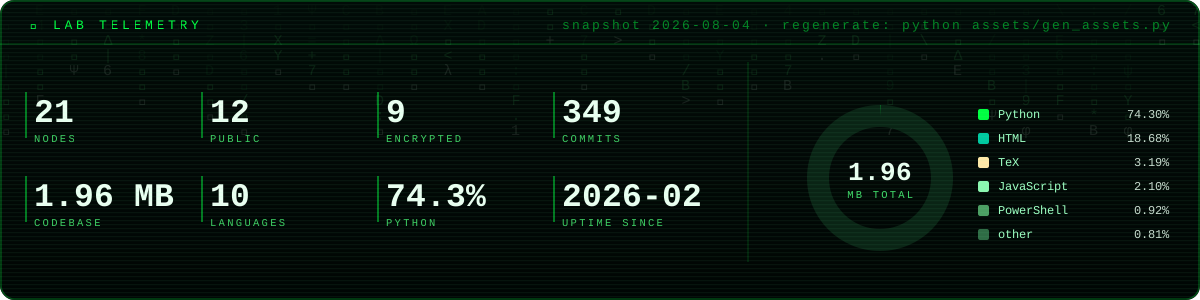
Every figure above is checkable against public files — see docs/EVIDENCE.md. Regenerate: python assets/gen_assets.py
Status vocabulary: Implemented (working code + tests) · Experimental (working code, results from simulation or single runs, no test suite) · Research notes (written analysis, no code) · Spec (design document only) · Infrastructure (publishing / tooling).
| Repository | What it is | Status | Directly verifiable evidence |
|---|---|---|---|
| QHDALabs-Axon | Verification-first inference over scientific literature. Two relation types with registered verifiers: lexical proximity (TF-IDF + empirical random-pair null + BH-FDR) and ABC bridge (Swanson closed discovery, two explicit nulls). | Implemented | 24 test modules, CI workflow, VERIFICATION_LOG.md, pre-registration docs in docs/, runnable corpora in data/ |
| QHDALabs-wildfire-risk-pl | Wildfire risk pipeline for Poland (v5: 33-node Lower Silesia forest-district graph). Ingests NASA FIRMS, OSM/Geofabrik, BDOT10k, CLC 2018; fuses ignition pressure, NDWI vegetation stress and topology into risk scores. | Implemented | v5/ pytest suite, v5/topology/*.json outputs, SHAP reports, generated maps, two technical notes (PDF) |
| qhda-core | Shared kernel: relational state, quantum circuit helpers, emergent-clock primitives. Consumed by Axon as a dependency. | Implemented | src/qhda_core/, tests/test_integration.py, examples/wildfire_relational.py, pyproject.toml |
| qmnet | Three Qiskit experiments: decoherence routing via ancilla coupling angle; measurement-fuelled conditional bridges in graph-state echo; RQTE, a 16-step construction where the key derives from an emergent measurement timeline. | Experimental | 4 runnable scripts, 2 technical notes (PDF), reported numbers reproducible on an ideal simulator in ~11 min total |
| QHDALabs-XSIG | Search for non-random cross-channel structure in ΛCDM residuals (Planck 2018 TT, D/H, He-4, α dipole + King+2012 raw absorbers, eBOSS BAO). | Experimental | Real Planck data in data/planck/, run scripts, result plots — published null result |
| QHDALabs-Genesis-Protocol | React voting frontend for collecting ethical-constraint preferences intended for a safety-by-design hardware module. | Experimental (local only) | Source runs via npm run dev. No public deployment exists. Hardware module and vote ledger are conceptual. |
| QHDALabs-RTANA | Question: can a neural architecture carry an internal relational clock rather than an external timestamp? | Research notes — no code | MANIFESTO.md, QUESTIONS.md, RESEARCH_LOG.md. Architecture, PoC and evaluation protocol are all unstarted. |
| QHDALabs-Universe | Umbrella for planned cosmology sub-projects (cosmoaudit, photon-engine, h0lab, reltime, cosmohub). | Spec / concept ("init alpha") | README only. No implementations, datasets or results. |
| qhda-coherence-bridge | Earliest design note: abstraction layer between relational quantum models and executable substrates. | Spec | Design description only (~9 KB). Superseded in practice by qhda-core. |
| qhdalabs.github.io | Research portal and papers index → live | Infrastructure | Deployed site |
| QHDALabs | This repository: profile, evidence documents, and the digital garden below. | Infrastructure | You are reading it |
| Multiverse-Theory | Research origin, earliest indexed 2025. The theoretical work the lab grew out of: time from information asymmetry, space from quantum correlations, reality as a dynamic quantum graph. Self-fork of the operator's personal account, brought under QHDALabs in 2026-04. | Theory + simulations — predates the lab | ~40 concept/model documents in docs/, 6 Qiskit simulation scripts in simulations/, 3 preprint sources in preprints/, LaTeX build CI, CITATION.cff + .zenodo.json. See lineage below. |
Licenses differ per repository (this one and qmnet are MIT; Axon is RCSAL v2.0). Check each repo.
On private work. Additional repositories are private. They are deliberately not offered as evidence and no claims are made about them; nothing in this document depends on them. Everything asserted above can be checked against public files today.
📄 Full claim-by-claim matrix: docs/EVIDENCE.md · Per-component status and roadmap: docs/PROJECT_STATUS.md
The lab is not a standing start. The implemented components descend from theoretical work whose earliest currently indexed artifacts date to April 2025, ten months before the QHDALabs account was created — a continuous line from theory, through algorithms, to applied systems. Every arrow below is traceable to files.
Provisional — this chronology is a working version. April 2025 is the earliest origin currently indexed in a public repository, not an established starting point. Earlier personal research artifacts exist that may belong to the same lineage and may predate it. A dedicated provenance reconstruction across the older archives is planned, to establish the earliest defensible origin of each line from actual files, dates and technical continuity. Until then this section deliberately neither shortens the history to 2025 nor claims older work that has not yet been shown to be continuous with it. The lineage links below are unaffected — they are file-to-file and stand on their own regardless of how far back the origin is ultimately dated.
flowchart LR
    subgraph T["① Research origin · 2025-04 → 2025-09"]
        MT["<b>Multiverse-Theory</b><br/>time from information asymmetry<br/>space from quantum correlations<br/>reality as a dynamic quantum graph"]
        MT1["docs/models/emergent_time.md<br/>emergent_time_decoherence.md"]
        MT2["docs/concepts/virtual_qubit.md<br/>simulations/time_shifted_clock.py<br/>simulations/qqc.py"]
        MT3["notebooks/preprint_qmnet.tex<br/>preprints/mass_as_information.tex"]
        MT --> MT1 & MT2 & MT3
    end

    subgraph A["② Algorithmic lineage · 2026-03 → 2026-06"]
        BR["<b>qhda-coherence-bridge</b><br/>first design note"]
        CORE["<b>qhda-core</b><br/>emergent/clock.py<br/>quantum/circuits.py<br/>relational/state.py"]
        QM["<b>qmnet</b><br/>star-Ising clock tick<br/>conditional bridges · RQTE"]
    end

    subgraph P["③ Applications · 2026-05 →"]
        AX["<b>Axon</b><br/>relations as the unit,<br/>verified before use"]
        FI["<b>wildfire-risk-pl</b><br/>relational topology<br/>over real infrastructure"]
        RT["<b>RTANA</b><br/>relational clock<br/>in neural systems"]
    end

    MT1 --> CORE
    MT2 --> QM
    MT3 --> QM
    MT --> BR --> CORE
    QM --> CORE
    CORE --> AX
    CORE --> FI
    QM --> RT

    classDef origin fill:#062313,stroke:#FFE9A8,stroke-width:1.5px,color:#FFE9A8
    classDef algo   fill:#04170d,stroke:#00C8A0,stroke-width:1.5px,color:#9DFFC2
    classDef app    fill:#04170d,stroke:#00FF41,stroke-width:2px,color:#EAFFF1
    class MT,MT1,MT2,MT3 origin
    class BR,CORE,QM algo
    class AX,FI,RT app
| Origin artifact (2025) | Descendant | How to check the link |
|---|---|---|
docs/models/emergent_time.md, emergent_time_decoherence.md |
qhda-core/src/qhda_core/emergent/clock.py |
The clock primitive implements the emergent-time model described in the 2025 documents |
docs/concepts/virtual_qubit.md, simulations/time_shifted_clock.py, simulations/qqc.py |
qmnet — the star-topology clock tick used in RQTE |
Both use a star-topology model to derive a tick that distinguishes one step from another |
notebooks/preprint_qmnet.tex / .pdf |
qmnet |
The qmnet preprint source sits in the theory repository — the bridge is a file, not a story |
docs/models/time_theory.md, relational-time material |
RTANA |
RTANA restates the relational-time question for neural architectures |
docs/models/topological_entanglement.md, quantum-graph material |
qhda-core/relational/state.py → Axon, wildfire graph topology |
"Relation is the unit" is the shared thesis, applied to literature and to infrastructure |
What this repository is and is not. It is a self-fork of the operator's personal account
(krzyshtoof/Multiverse-Theory), brought under QHDALabs in April 2026; all commits are the
operator's own across both accounts. It contains theoretical documents, six Qiskit simulation
scripts and three preprint sources — not peer-reviewed, and largely not experimentally tested.
It is offered as the provenance of the algorithms, not as validation of them. The claims that
carry weight are the ones in the implemented components above, which can be run.
The lab's operating rule is that a hypothesis is registered before it is tested, and a failure ends the line rather than being quietly re-scoped. Four documented instances:
| Study | Pre-registered? | Outcome | Where |
|---|---|---|---|
Axon PROXIMITY — 780 pairs from a 40-document arXiv corpus |
Null model fixed in advance | Null. 34 nominally significant pairs; 0 survive BH-FDR at α=0.05. Reported as the correct answer, not a failure. | VERIFICATION_LOG.md |
Axon ABC_BRIDGE — in-sample positive control (Swanson's Raynaud / fish-oil, 717 pre-1986 MeSH records) |
Yes | Recovered. direct_sim = 0.046, mediated = 5.10, p_random = 0.0345. | same |
Axon ABC_BRIDGE — pre-registered held-out case (migraine / magnesium), statistics frozen before the run |
Yes | Failed to recover (p_random = 0.1214). Worse, a sibling literature (cluster headache, direct_sim = 0.283) would have been falsely accepted at q = 0.0135 — so the gate cannot separate siblings from true bridges. Documented rather than dropped. | same |
| Axon V2-A Tier-0 confirmatory, frozen pre-registration, R = 200, 11 cells | Yes | Failed the contract cell thin_half_n4 (degradation 0.53 < 0.80 required). Latent-parent control passed. Per protocol, development stopped; Tier 1 was never attempted. |
docs/ABC_BRIDGE_V2A_TIER0_PRE_REGISTRATION.md |
| XSIG — cross-channel structure in ΛCDM residuals, 500 bootstrap permutations | Positive control run first on synthetic injection (d ≈ 2.5, p < 0.0001) | Null confirmed. Best real-data test z = +1.29, p = 0.108; no test reached p < 0.05. Replacing the smooth α dipole model with raw King+2012 absorbers removed the apparent signal — i.e. the earlier hint was a model artifact, and this is stated. | XSIG README |
A comparable gate exists in the applied work: the wildfire pipeline blocks fusion output when
layer coverage falls below 70% or fewer than three data sources are present, and returns null
rather than a fabricated score.
The same rule applies to qmnet: the BUTTERFLY irreversibility class produced lower timeline
entropy (0.811 bit) than the other modes (≈1.0), which was the opposite of the expectation. It is
reported as an open question, not smoothed over.
Edges below are actual dependencies or documented derivations, not aspiration.
flowchart TD
    CORE["<b>qhda-core</b><br/>relational state · circuit helpers<br/>emergent-clock primitives<br/><i>implemented · tested</i>"]

    AXON["<b>QHDALabs-Axon</b><br/>verification-first inference<br/>over scientific literature<br/><i>implemented · tested · CI</i>"]
    FIRE["<b>wildfire-risk-pl</b><br/>operational risk pipeline (PL)<br/><i>implemented · tested</i>"]
    QMNET["<b>qmnet</b><br/>measurement-fuelled bridges · RQTE<br/><i>experimental · ideal simulator only</i>"]
    XSIG["<b>QHDALabs-XSIG</b><br/>ΛCDM residual structure search<br/><i>experimental · null result</i>"]
    GEN["<b>Genesis-Protocol</b><br/>ethical-constraint voting UI<br/><i>experimental · local only</i>"]

    MT["<b>Multiverse-Theory</b><br/>theoretical origin, 2025<br/><i>theory + simulations</i>"]
    RTANA["<b>QHDALabs-RTANA</b><br/>relational time in neural nets<br/><i>research notes · no code</i>"]
    UNI["<b>QHDALabs-Universe</b><br/>cosmology umbrella<br/><i>spec / concept</i>"]
    BRIDGE["<b>qhda-coherence-bridge</b><br/>earliest design note<br/><i>spec</i>"]

    DATA[("public data<br/>Planck · FIRMS · OSM<br/>BDOT10k · CLC · MEDLINE")]
    PORTAL["<b>qhdalabs.github.io</b> + this profile<br/><i>publishing</i>"]

    MT -.->|emergent_time.md| CORE
    MT -.->|virtual_qubit · preprint_qmnet| QMNET
    CORE -->|pip dependency| AXON
    CORE -->|examples/wildfire_relational.py| FIRE
    BRIDGE -.->|superseded by| CORE
    QMNET -->|motivates| RTANA
    QMNET -->|primitives shared with| CORE

    DATA --> AXON
    DATA --> FIRE
    DATA --> XSIG

    AXON --> PORTAL
    FIRE --> PORTAL
    QMNET --> PORTAL
    XSIG --> PORTAL
    GEN --> PORTAL
    UNI -.-> PORTAL

    classDef impl  fill:#04170d,stroke:#00FF41,stroke-width:2px,color:#EAFFF1
    classDef exp   fill:#04170d,stroke:#00C8A0,stroke-width:1.5px,color:#9DFFC2
    classDef notes fill:#0d1117,stroke:#4C9E63,stroke-width:1.2px,color:#8CF7B0
    classDef data  fill:#062313,stroke:#FFE9A8,stroke-width:1.5px,color:#FFE9A8
    class CORE,AXON,FIRE impl
    class QMNET,XSIG,GEN exp
    class RTANA,UNI,BRIDGE,MT notes
    class DATA,PORTAL data
Trust boundaries. All external data enters through fetch scripts that pin and checksum what they download (wildfire FIRMS downloads are validated atomically with SHA-256 across 73 five-day windows for 2025). Quantum work runs on local Qiskit Aer simulators only — no cloud QPU credentials are used anywhere in the public code. Genesis-Protocol calls an external LLM API and World ID from the browser; it is a local prototype and must not be treated as a deployed system.
Each repository is self-contained. The three fastest independent checks:
1. Reproduce Axon's null result and its pre-registered failure (~5 min):
git clone https://github.com/QHDALabs/QHDALabs-Axon && cd QHDALabs-Axon
pip install "git+https://github.com/QHDALabs/qhda-core.git" && pip install .
python examples/mvp_proximity_null.py      # expect: 0 relations survive BH-FDR
python examples/abc_bridge_recovery.py     # expect: Raynaud/fish-oil recovered, p_random≈0.0345
python examples/migraine_magnesium_heldout.py  # expect: NULL verdict, p_random≈0.1214
pytest
2. Reproduce the quantum bridge and RQTE experiments (~11 min, ideal simulator):
pip install "qiskit>=1.0" "qiskit-aer>=0.13" numpy scipy matplotlib
git clone https://github.com/QHDALabs/qmnet && cd qmnet
python qmnet_v3.py     # expect: P_ret = 0.000 at T=2,4 in the m=1 branch
python rqte_v3.py      # expect: correct decrypt in all 3 modes; BUTTERFLY entropy ≈0.811
3. Run the wildfire pipeline without credentials (stub mode, ~2 min):
git clone https://github.com/QHDALabs/QHDALabs-wildfire-risk-pl && cd QHDALabs-wildfire-risk-pl/v5
pip install -r requirements.txt
python qhdalabs_wildfire_ignition_v1.py --stub   # synthetic inputs, no API key needed
pytest
Live FIRMS ingestion needs a free NASA FIRMS_MAP_KEY. Two of the seven wildfire layers
(ARiMR LPIS, IBL KSIPL) have no automated source and must be imported manually — so a full
end-to-end run is not reproducible from a clean checkout without those files. This is a real
gap, stated rather than hidden.
Stated plainly, because an evaluator will find them anyway:
- No peer review. No output has been through external review or publication. The technical
notes in
qmnetandwildfire-risk-plare self-published PDFs. - No physical quantum hardware. Every quantum result is from a noise-free Qiskit Aer simulator. No noise model has been applied; no QPU run has happened. Scaling beyond 5 qubits is untested.
- RQTE is not cryptography yet. No security proof, no attacker model, no NIST SP 800-22 randomness testing. It is a construction that encrypts and decrypts correctly in simulation.
- Axon's bridge gate does not generalise. It works for closed discovery in-sample and fails on the pre-registered held-out case and on sibling-literature separation. Development is halted at that boundary by design.
- XSIG is limited by window count. 16 observational windows is acknowledged as insufficient; shared instrumental systematics across the five channels cannot be excluded; BAO enters through a parametric model rather than raw data.
- Wildfire validation is partial. Coverage-gating and EFFIS comparison exist; there is no published skill score against a held-out fire season, and the pipeline covers one voivodeship.
- Single operator, no institutional affiliation. No lab partners, no funding, no external replication of any result.
- Three repositories contain no code at all (RTANA, Universe, coherence-bridge). They are labelled as such above.
| Horizon | Work | Depends on |
|---|---|---|
| Done | Axon MVP pipeline + two verifiers + pre-registration protocol · wildfire v1→v5 · qmnet three experiments · XSIG null result · qhda-core extraction | — |
| Now | Axon: repair or replace the sibling-separation gate that failed Tier-0 · wildfire: skill scoring against a held-out season | Existing code |
| Next | NIST SP 800-22 on the RQTE keystream · qmnet under a realistic noise model · first QPU run (IBM Heron target) of the 4-step variant · extend wildfire beyond Lower Silesia | Compute + QPU access |
| Research | RTANA: turn the manifesto into an architecture proposal and a falsifiable evaluation protocol · XSIG with more observational windows · relational primitives as a shared substrate across the above | Open questions, not scheduled |
Nothing in the Next or Research rows is claimed to exist.
Working notes and long-form write-ups, published as they are written.
| 🌱 Blog | RQTE v3.0 — when measurement creates time (the full experimental write-up, including the result that went the wrong way) · infrastructure notes · AGI notes |
| 🔬 Research notes | Quantum · Relational time · Energy |
| 📓 Knowledge base | ISO 27001 / ISMS practice notes |
| 📡 News | Release notes and status updates |
Published via GitHub Pages (workflow) → qhdalabs.github.io
Python (Qiskit · NumPy · SciPy · pandas · NetworkX · GeoPandas · scikit-learn/SHAP) · JavaScript/React · TeX · GitHub Actions · GitHub Pages
| Quantum & relational | Scientific inference | Applied risk systems | Security |
|---|---|---|---|
| Relational quantum mechanics (Rovelli, Page–Wootters) · mid-circuit measurement as conditional structure · decoherence routing · hybrid quantum–classical | Null-model design · multiple-testing correction · pre-registration · literature-based discovery (Swanson ABC) | Geospatial fusion · satellite ingestion (Sentinel-2 NDWI, FIRMS) · graph topology over infrastructure · explainability (SHAP) | ISMS / ISO 27001 practice · supply-chain hygiene (pinned, checksummed data fetches) |
Open to collaboration with researchers, engineers, institutions and reviewers — particularly on
external replication, noise-model and QPU access for qmnet, and validation data for the wildfire
pipeline.
If you find an error in any result here, please open an issue on the relevant repository. Negative findings about this work are as welcome as positive ones.


Lab principles — the working rules behind the method above
01Do not bend the spoon. Bend the model until it predicts the spoon.
02Verification before discovery. A result nobody can reproduce is a rumour with LaTeX.
03Relation is the unit. The object is what remains when you forget the relations.
04Sit with the problem long enough and it stops being a problem — it becomes structure.
05Form is emptiness; emptiness is form. Both compile. Only one runs in production.
06Think in decades. Ship on Tuesdays.
These are not decoration. 02 is why VERIFICATION_LOG.md exists and why the Tier-0 failure
stopped development instead of being re-scoped. 03 is the shared thesis across qhda-core,
qmnet and Axon. 06 is why an operational wildfire pipeline sits next to cosmology.
Long-term direction. Quantum computation, machine intelligence, energy and infrastructure resilience are converging. QHDALabs works at that intersection with a deliberately narrow method: build the smallest verifiable thing, test it against an explicit null, publish what happened. That direction is an intention, not a capability claim.

MIT licensed (this repository) · © 2026 Krzysztof W. Banasiewicz