
A private, fully offline personal finance tracker.
No cloud. No sync. No bank credential sharing. No account to create anywhere but on your own device. Sloth stores everything locally in an encrypted SQLite database and never talks to a server — because it doesn't have one.
Most finance apps ask you to hand over your bank login to a third party so they can "aggregate" your data — which really means it now lives on someone else's servers, subject to someone else's breach history, business model, and terms of service. Sloth takes the opposite approach: your transactions never leave your phone.
Click the image below to watch the demo on YouTube.
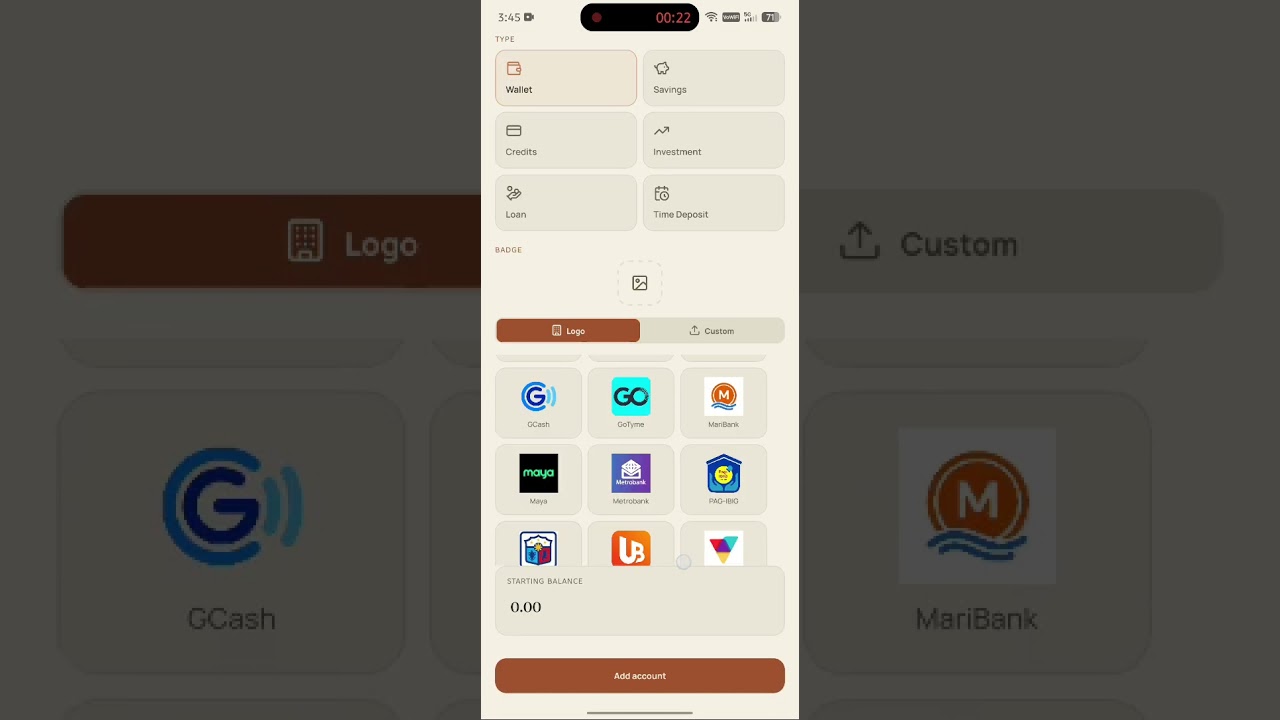
- Manual entry, receipt scan, or file import — never bank-login aggregation
- On-device OCR for receipt scanning (no cloud vision API)
- Local categorization via a lightweight keyword/Bayesian classifier — no data leaves the device to "learn" from your spending
- Encrypted at rest — SQLite via op-sqlite + SQLCipher
- Biometric lock (Face/Touch ID) with a 6-digit PIN fallback
- Multi-account support — checking, savings, credit, cash, with custom logos/colors
- CSV / XSLX import for bulk-loading bank exports, parsed entirely on-device
- Manual export — your data, your backup, on your terms
- React Native + Expo
- op-sqlite with SQLCipher for encrypted local storage
- NativeWind for styling
- lottie-react-native for onboarding and key-screen animations
- Bun as the package manager / runtime
Currently developed Android-first; iOS support is a future target.
Sloth is in active development. Implementation is ongoing.
Bug reports and feature requests are welcome via GitHub Issues. See CONTRIBUTING.md before opening a PR — it covers the project's non-negotiables (no network calls, on-device-only processing, encryption must stay intact) and what the license means for contributions.
Sloth is licensed under the GNU General Public License v3.0 (GPLv3) — see LICENSE.
In short: you're free to use, study, modify, and share Sloth. If you distribute a modified version — a fork, a rebrand, a build with your own features — you must also make your source available under GPLv3. Forks stay open. That's intentional: a tool built around financial privacy shouldn't itself be a closed box, and we want that to hold for anything built on top of it too.